AI estimate as of October 23, 2025 · verify with a professional before acting
AI-Generated · Verify before acting
Everything on this page is generated by AI for informational purposes only. AI can make mistakes — the AI may misidentify items or misattribute them (artist, maker, brand, designer, origin, era). This is not an official valuation and should not be used for insurance, sale, tax, estate, legal, or lending purposes — or any decision requiring a certified appraisal. It is not an authoritative claim about any person, brand, or rights holder — do not share or rely on it as a factual statement about a third party. Always consult qualified professionals before making financial decisions.
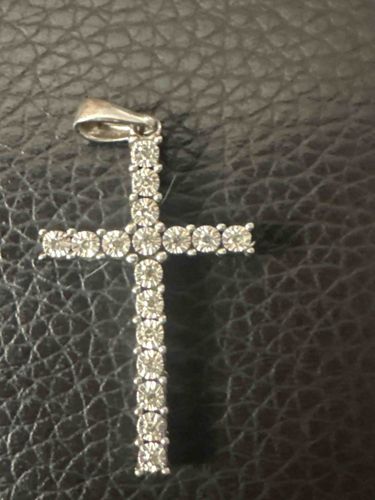
This item is a cross-shaped pendant, likely crafted from a base metal and plated with rhodium, visible by its bright, reflective silver color. The entire surface of the cross is adorned with numerous small, round, brilliant-cut cubic zirconia (CZ) stones, set in a pave style, giving the appearance of a solid surface of sparkle. The stones are evenly distributed across both the vertical and horizontal bars of the cross. Each stone appears to be individually prong-set, with tiny prongs securing them in place, although the small scale makes it difficult to ascertain the exact setting technique without magnification. The overall construction suggests a solid, well-defined shape. A bail, likely also rhodium-plated, is attached to the top of the vertical bar of the cross, designed for suspension from a chain. The bail is simple and smoothly finished, showing no obvious wear or damage. The visible condition of the pendant appears good, with no apparent missing stones, significant scratches, or tarnishing on the rhodium plating. The craftsmanship appears to be commercial grade, common for mass-produced jewelry featuring simulated diamonds. While no specific maker's marks or signatures are visible in the image, the style is contemporary, suggesting an estimated age from the late 20th century to the present day. This piece is a classic representation of a diamond-alternative cross pendant, popular for its symbolic meaning and decorative appeal.
AI Appraisal Report
Based on my visual examination of the Rhodium-Plated Pave Set CZ Cross Pendant, the item appears to be in very good condition. All cubic zirconia stones are present, and the rhodium plating exhibits a consistent, bright finish with no visible signs of wear, tarnish, or significant scratching. The pave setting style, while effective in creating continuous sparkle, is characteristic of commercially produced fashion jewelry. Authenticity, in this context, refers to the composition and manufacturing methods rather than historical provenance, given its contemporary style. Without physical inspection, I cannot definitively confirm the base metal composition or the precise setting technique (e.g., individual prongs vs. shared prongs), but the visual evidence strongly supports the description of rhodium plating over a base metal with CZ stones.
Market conditions for rhodium-plated CZ jewelry are influenced by its accessibility and mass production. Comparable items, widely available from various retailers, are generally priced at the lower end of the fashion jewelry spectrum. Demand for such pieces is consistent due to their attractive appearance and affordability, though they lack rarity. Factors significantly impacting value include the use of simulated stones (CZ) and the plated nature of the metal rather than solid precious metals. Should this item have been crafted from solid sterling silver or gold, or set with natural diamonds, the value would be substantially higher. However, as presented, its value aligns with decorative, costume-grade jewelry.
Limitations in authenticity verification from the image alone mean I cannot confirm karatage (if it were gold), specific metal composition, or conduct any diamond testing (which would confirm they are CZs). An in-person examination would allow for precise testing of the metal, confirmation of stone identity, and detailed inspection of craftsmanship under magnification to verify setting quality and detect any potential flaws or base metal exposure not visible in the image.