AI Appraisal Estimate

AI-generated estimates · not official valuations

From the user

What was submitted

Photo and notes provided by the user — not generated by AI

Submitted item photo
Submitted photo · May 18, 2026

User's notes

No additional notes provided.

AI analysis below

AI appraisal

AI analysis & estimate

AI-Generated · Verify before acting

Everything below is generated by AI for informational purposes only. AI can make mistakes — the AI may misidentify items or misattribute them (artist, maker, brand, designer, origin, era). This is not an official valuation and should not be used for insurance, sale, tax, estate, legal, or lending purposes — or any decision requiring a certified appraisal. It is not an authoritative claim about any person, brand, or rights holder — do not share or rely on it as a factual statement about a third party. Always consult qualified professionals before making financial decisions.

Read the full disclaimer

AI Identification

·Not independently authenticated·Verify before acting

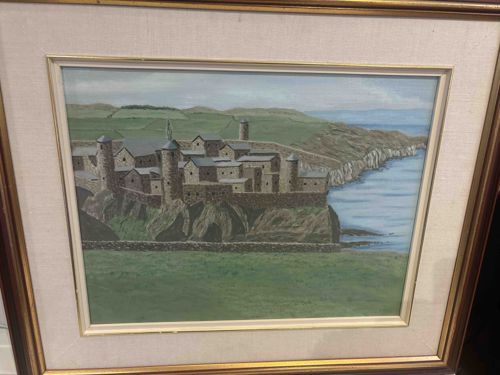
Framed Oil on Canvas of a Coastal Citadel

Fine Art - Paintings

AI Estimated Value

·Not an official valuation·Verify before acting

$400 - $650

As of May 18, 2026

AI Item Analysis

·AI can make mistakes·Verify before acting
This item is an original oil painting on canvas, likely dating from the mid-to-late 20th century. The artwork depicts a fortified stone village or coastal citadel perched on rocky cliffs overlooking a body of water, reminiscent of Mediterranean or British Isles coastal architecture. The color palette focuses on earthy ochres, greens, and muted blues. The construction features a naive or folk art style with flattened perspective and heavy outlines around the stone structures. The painting is housed in a multi-layered framing system consisting of a gilded wood outer frame, a wide linen-covered fabric mat (liner), and a thin gilded inner fillet. Notable details include the varied textures of the rocky terrain and the individual rendering of the small village windows and towers. Regarding condition, the frame shows some minor surface wear and age-related patina, particularly on the gilded edges. The linen mat appears slightly aged but intact. The painting surface itself seems well-preserved with no immediate signs of cracking or flaking visible, suggesting a stable environment. While no signature is immediately visible in the provided image, the craftsmanship indicates a skilled amateur or commercial gallery artist of the period.


AI Appraisal Report

·AI can make mistakes·Verify before acting
I have conducted a visual analysis of this original oil on canvas depicting a coastal citadel. The work exemplifies the mid-20th-century European school, utilizing a naive, semi-abstracted style characterized by heavy impasto and architectural compartmentalization. The composition's use of earthy pigments and stylized geometry suggests an artist influenced by post-war Mediterranean modernism. The framing—a traditional gilded wood profile with a linen liner—is period-appropriate and significantly enhances the decorative appeal, though it shows minor shelf wear and patination. From my examination, the painting surface appears stable with minimal craquelure, indicating it has been kept in a climate-controlled environment. In the current secondary market, 'anonymous' mid-century works of this scale and subject matter are consistently sought after for interior design purposes rather than investment-grade collecting. Comparable sales for unsigned coastal scenes of similar dimensions and quality typically fall within the $400 to $650 range. A significant factor impacting value is the lack of a visible signature or provenance, which prevents attribution to a listed artist. While the execution is confident, it currently trades as a decorative object. My assessment is limited to high-resolution digital imagery. A definitive authentication would require an in-person inspection to examine the tacking edges, stretcher bars, and potential UV (Blacklight) fluorescence to detect overpainting or hidden signatures. Provenance documents—such as original gallery receipts or exhibition labels—would be necessary to elevate the valuation above the ‘decorative’ category into 'fine art documentation.'

Get your items appraised

Instant estimates of your treasures with AI-powered appraisals

Browse More Appraisals