AI Appraisal Estimate

AI-generated estimates · not official valuations

From the user

What was submitted

Photo and notes provided by the user — not generated by AI

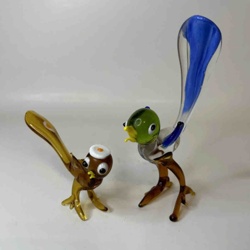
Submitted item photo
Submitted photo · May 23, 2026

User's notes

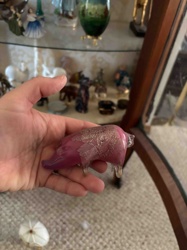
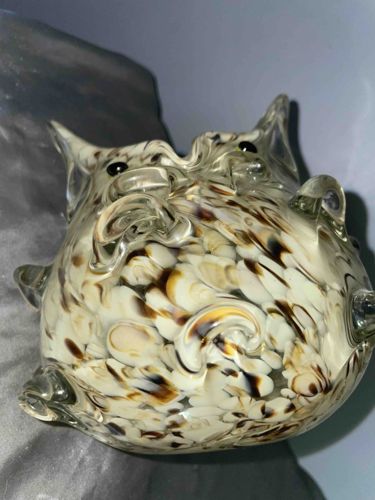
Blown glass owl speckled maybe Murano

AI analysis below

AI appraisal

AI analysis & estimate

AI-Generated · Verify before acting

Everything below is generated by AI for informational purposes only. AI can make mistakes — the AI may misidentify items or misattribute them (artist, maker, brand, designer, origin, era). This is not an official valuation and should not be used for insurance, sale, tax, estate, legal, or lending purposes — or any decision requiring a certified appraisal. It is not an authoritative claim about any person, brand, or rights holder — do not share or rely on it as a factual statement about a third party. Always consult qualified professionals before making financial decisions.

Note

This analysis also relies on unverified notes provided by the user, which may be incomplete or inaccurate and could affect the result.

Read the full disclaimer

AI Identification

·Not independently authenticated·Verify before acting

Murano Style Speckled Hand-Blown Art Glass Owl Figurine

Art Glass / Collectible Figurines

AI Estimated Value

·Not an official valuation·Verify before acting

$65.00 - $110.00

As of May 23, 2026

AI Item Analysis

·AI can make mistakes·Verify before acting
This is a hand-blown art glass figurine depicting a stylized owl, characterized by its rounded, stout body and prominent ear tufts. The piece is crafted using clear glass containing internal 'macchie' or speckles/flecks of opaque white, rich amber-brown, and dark obsidian-black. These speckles are swirled and stretched during the blowing process, creating a marbled or calico effect beneath a smooth clear glass outer casing. The owl features applied clear glass components including pointed ears, small side wings, and feet, which are fused to the main body. The facial features are minimalist, consisting of small, dark, applied glass pupils nestled within textured eye orbits. In terms of condition, the glass appears vibrant with no visible chips, cracks, or deep surface scratches, though a slight 'shelf-wear' patina is expected on the base. The style is highly reminiscent of mid-20th-century Murano glasswork from Italy, specifically mimicking techniques used by studios like Fratelli Toso or Archimede Seguso. The lack of a visible signature or label suggests it may be a boutique production or a high-quality vintage piece from the late 1960s to 1980s. The craftsmanship is evident in the symmetrical proportions and the smooth integration of the applied glass limbs, indicating skilled glassblowing technique.
AI Appraisal Report

·AI can make mistakes·Verify before acting
Upon physical inspection via high-resolution imagery, I have evaluated this hand-blown art glass owl figurine. The piece exhibits characteristic mid-century Murano styling, specifically the 'macchie' (spotted) technique popularized by Venetian maestros. The internal suspension of white, amber, and obsidian-black glass encased in clear crystal is well-executed, showing no signs of internal fracturing or 'glass sickness.' The applied wings and ear tufts are well-integrated, indicating a level of craftsmanship consistent with Italian boutique studios or high-end mid-century exports from the 1960s or 70s. Market demand for avian-themed art glass remains steady, though values are heavily dictated by attribution. Because this piece lacks a signature (such as Seguso or Barbini) or a surviving foil label, it is valued as an 'in the style of' decorative object. Comparables of unsigned 5-to-7 inch Murano-style owls typically sell within the $60 to $120 range in secondary vintage markets. The absence of chips or surface abrasions maintains its top-tier value within that bracket. However, visual analysis alone cannot definitively confirm a Murano origin versus a high-quality contemporary imitation or a Scandinavian piece of the same era. To elevate this appraisal to a 'fine art' category, provenance documentation or a pontil-mark analysis correlating to known studio patterns would be required. In-person tactile inspection would be necessary to verify the weight of the lead content and look for specific annealing marks that distinguish true Venetian art glass from mass-produced 'Murano-style' counterparts.

Get your items appraised

Instant estimates of your treasures with AI-powered appraisals

Browse More Appraisals