These notes were written by the person who submitted this item. Appraiser.AI has not verified them, and the AI's identification and estimate may rely on them.
AI Estimated Value
Not an official valuation
$60-100
AI estimate as of July 10, 2025 · verify with a professional before acting
AI-Generated · Verify before acting
Everything on this page is generated by AI for informational purposes only. AI can make mistakes — the AI may misidentify items or misattribute them (artist, maker, brand, designer, origin, era). This is not an official valuation and should not be used for insurance, sale, tax, estate, legal, or lending purposes — or any decision requiring a certified appraisal. It is not an authoritative claim about any person, brand, or rights holder — do not share or rely on it as a factual statement about a third party. Always consult qualified professionals before making financial decisions.
This analysis also relies on unverified notes provided by the user, which may be incomplete or inaccurate and could affect the result.
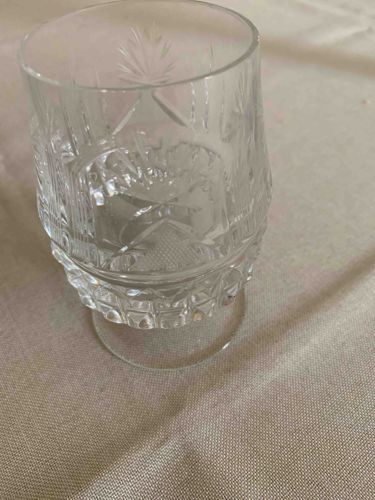
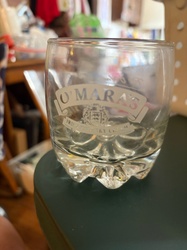
The item is a clear crystal or leaded glass tumbler, likely a whiskey glass or old-fashioned glass, characterized by its substantial weight and intricate cut glass patterns. The glass features a short, wide cylindrical body that tapers slightly outward towards the rim. The primary material is high-quality, clear, colorless glass, exhibiting excellent clarity and light refraction, indicative of crystal or a high lead content. The decorative cutting covers almost the entire body of the glass, starting from just below the smooth rim. The patterns visible include a fan or starburst motif near the top, along with various geometric cuts such as cross-hatching, vertical flutes, and diamond patterns. The base of the glass is thick and solid, with an applied foot or stem that is very short, almost flush with the bottom of the body, providing stability. The bottom edge of the glass itself also appears to have a ring of decorative cuts, possibly small facets or hobnail-like elements, adding to its visual weight and complexity. No obvious maker's marks or signatures are visible from the provided images. The condition appears to be very good with no visible chips, cracks, or significant scratches, suggesting careful handling over time. The craftsmanship is evident in the precise and detailed cuts, which would have been laborious to achieve, pointing to a quality piece. It likely dates from the early to mid-20th century, a popular period for elaborately cut glassware. The overall impression is one of elegance and durability, typical of fine barware designed for formal or semi-formal settings.
AI Appraisal Report
Based on my visual examination of the image and the owner's description, this Cut Crystal Tumbler / Whiskey Glass exhibits characteristics of high-quality early to mid-20th century American Brilliant Cut Glass, or a similar European counterpart. The intricate fan, cross-hatch, and diamond patterns, along with the substantial thickness and evident light refraction, strongly suggest leaded crystal. The condition appears to be very good; I observe no visible chips, cracks, or significant scratches, which is excellent for a piece of this age and fragility. This indicates careful handling and storage. Authenticity, based purely on visual inspection, leans towards genuine leaded crystal, given the clarity, brilliance, and complexity of the cuts. However, without a physical examination, I cannot perform a "ring test" (tapping the glass lightly to hear the distinct crystal resonance) or confirm the lead content through scientific means. Discerning the exact manufacturer (e.g., Libbey, Hawkes, Dorflinger) without a maker's mark is also challenging from images alone; an in-person examination might reveal acid-etched marks or specific pattern characteristics. The market for well-preserved vintage cut crystal remains stable, though not as robust as it once was, due to evolving aesthetic preferences. Comparable pieces from known high-quality manufacturers, especially in excellent condition, command higher prices. Demand for single tumblers is moderate; sets, if available, would fetch a premium. Rarity depends heavily on the specific pattern and maker, which I cannot definitively determine. Factors significantly impacting value include its excellent condition, the undeniable craftsmanship, and the material quality. However, the lack of a discernible maker's mark and the inability to physically inspect for authenticity and specific nuances of the pattern are limiting factors in establishing a higher, more definitive value. For full authentication and to ascertain a precise manufacturer, an in-person appraisal, possibly involving blacklight examination for repairs or specific pattern identification against known catalogs, and provenance documentation, would be necessary.