AI estimate as of August 18, 2025 · verify with a professional before acting
AI-Generated · Verify before acting
Everything on this page is generated by AI for informational purposes only. AI can make mistakes — the AI may misidentify items or misattribute them (artist, maker, brand, designer, origin, era). This is not an official valuation and should not be used for insurance, sale, tax, estate, legal, or lending purposes — or any decision requiring a certified appraisal. It is not an authoritative claim about any person, brand, or rights holder — do not share or rely on it as a factual statement about a third party. Always consult qualified professionals before making financial decisions.
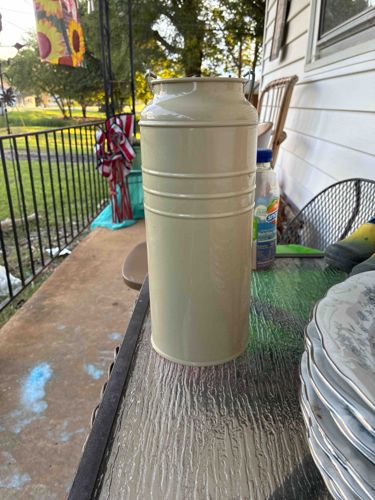
The item is a tall, cylindrical metal container, likely a repurposed or decorative milk can, painted in a uniform, light off-white or very light beige color. It features several horizontal embossed or raised bands around its circumference; two bands are present near the top, and two more are positioned in the middle section of the body, adding visual interest and possibly structural reinforcement. The top rim is slightly wider than the main body, and two small, arcing wire or thin metal handles are attached to the upper edges, suggesting portability. The surface appears smooth and evenly painted, indicating a relatively recent finish or good preservation. There are no obvious signs of significant wear, dents, or rust visible from the provided perspective, suggesting it is in good condition, perhaps having been recently cleaned or refinished. The construction appears to be of sheet metal, possibly steel or aluminum, consistent with traditional dairy containers, though its current use seems to be decorative rather than functional for liquids. The absence of maker's marks or signatures makes precise manufacturing details and age difficult to discern, but its style aligns with vintage farmhouse or rustic aesthetic popular in the mid-20th century, even if it's a modern reproduction. The craftsmanship appears competent, with clean lines and a consistent finish.
AI Appraisal Report
Upon examining the provided image, I assess this decorative metal cylinder, likely a repurposed milk can, to be in very good condition. The uniform, light off-white paint finish appears smooth and intact, with no visible dents, rust, or significant wear. This suggests either excellent preservation or recent refinishing. Authenticity as a true vintage milk can is difficult to ascertain solely from the image; it could be a well-maintained original, a quality reproduction, or a modern decorative piece in a vintage style. The absence of maker's marks or signatures prevents definitive determination of its origin or precise age.
In terms of market conditions, items like this fall into the decorative home accessories category, often appealing to farmhouse, rustic, or shabby chic aesthetics. Comparable items, ranging from genuine antique milk cans (often rusty or with original patina) to newly manufactured decorative versions, typically sell for $75-$200 depending on size, condition, and decorative appeal. This specific item's clean, neutral finish enhances its broad appeal and ease of integration into various decor styles. Demand for such decorative pieces is steady, but they are not particularly rare.
The primary factor impacting value is its excellent cosmetic condition, making it ready for immediate display without restoration. However, its likely decorative rather than functional origin, or extensive refinishing, limits its appeal to serious antique collectors. Its value lies predominantly in its aesthetic contribution.
Limitations in authenticity verification are significant. Without physical inspection, I cannot confirm the metal type, age of the underlying material, or detect subtle signs of wear beneath the paint. To definitively authenticate it as a period piece, I would require in-person examination to check for construction methods, seam types, internal wear patterns, and potential hidden marks. Provenance documentation or scientific testing of the paint layers could also help determine its true age and history.