AI estimate as of October 23, 2025 · verify with a professional before acting
AI-Generated · Verify before acting
Everything on this page is generated by AI for informational purposes only. AI can make mistakes — the AI may misidentify items or misattribute them (artist, maker, brand, designer, origin, era). This is not an official valuation and should not be used for insurance, sale, tax, estate, legal, or lending purposes — or any decision requiring a certified appraisal. It is not an authoritative claim about any person, brand, or rights holder — do not share or rely on it as a factual statement about a third party. Always consult qualified professionals before making financial decisions.
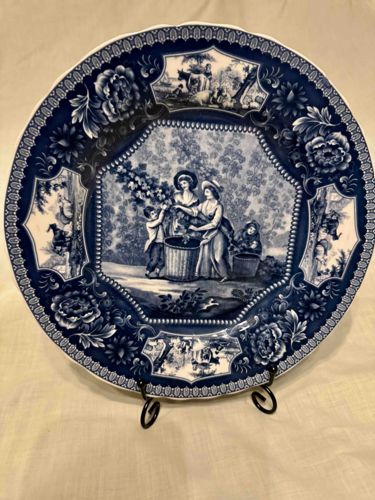
This is a circular decorative plate, likely made of ceramic or porcelain, featuring an intricate blue and white transferware design. The plate has a scalloped or gently undulating rim, which adds to its decorative appeal. The primary color scheme is a vibrant cobalt blue against a white background, a classic combination for transferware. The central octagonal motif depicts a bucolic scene of several figures, including women and children, engaged in what appears to be a grape harvest or similar rural activity, with vines overhead and tubs or baskets around them. This central image is framed by a thin dotted border and an elaborate rococo-style cartouche in darker blue. Surrounding this central panel is a wide border richly decorated with large, stylized floral elements, possibly peonies or similar full-bodied blossoms, intertwined with foliage. Interspersed within this floral border are four smaller, framed vignettes, also depicting pastoral or rural scenes. One vignette clearly shows figures with livestock, possibly cows, while others showcase various daily life activities or landscapes. The outermost edge of the plate features a continuous, repetitive pattern of small ovals or beads, adding another layer of intricate detailing. The craftsmanship appears to be of good quality, with crisp lines in the transfer print, suggesting a well-executed manufacturing process. There are no obvious signs of significant wear, chips, cracks, or repairs visible from the provided image, indicating it is in good to excellent condition, possibly used for display rather than daily dining. The style points to an 18th or 19th-century aesthetic, characteristic of historical transferware productions. The detail and complexity of the design suggest this could be a collectible piece.
AI Appraisal Report
I have visually examined this Blue and White Transferware Decorative Plate with Rural Scenes. The plate presents as a classic example of transferware, likely ceramic or porcelain, with a vibrant cobalt blue design against a white background. The scalloped rim and intricate detailing, including the central octagonal scene of a grape harvest and surrounding floral motifs with smaller pastoral vignettes, suggest a manufacturing period in the 18th or 19th century. The crisp lines of the transfer print indicate good quality craftsmanship. Based on the provided image, the condition appears to be good to excellent, with no visible chips, cracks, or repairs, suggesting it was primarily a display piece.
Market conditions for transferware like this are generally stable but not experiencing significant spikes. Comparable pieces, particularly those from well-known manufacturers with identifiable patterns, tend to fetch higher prices. This piece, while aesthetically pleasing and detailed, lacks apparent maker's marks from the image, which would significantly impact its top-tier value. Demand exists among collectors of antique ceramics and transferware, but without knowing the specific pattern name or manufacturer, it falls into a broader category. Its rarity is difficult to ascertain without more information, but similar decorative plates from this era are relatively common.
Factors impacting its value positively include its excellent visual condition and intricate design. Negatively, the lack of visible maker's marks or a known pattern limits its collectible premium. Without an in-person examination, I cannot definitively verify authenticity, the presence of hairline cracks not visible in photos, or any professional repairs. A physical inspection would allow me to check for pottery marks on the reverse, assess the true condition, and determine the exact material. Provenance documentation could also significantly enhance its value by confirming its history and origin.