AI estimate as of October 25, 2025 · verify with a professional before acting
AI-Generated · Verify before acting
Everything on this page is generated by AI for informational purposes only. AI can make mistakes — the AI may misidentify items or misattribute them (artist, maker, brand, designer, origin, era). This is not an official valuation and should not be used for insurance, sale, tax, estate, legal, or lending purposes — or any decision requiring a certified appraisal. It is not an authoritative claim about any person, brand, or rights holder — do not share or rely on it as a factual statement about a third party. Always consult qualified professionals before making financial decisions.
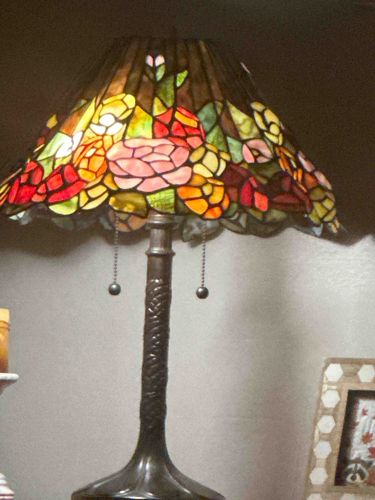
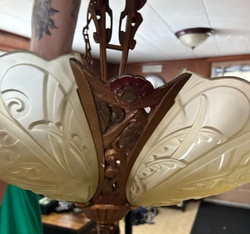
This is a Tiffany-style table lamp featuring a vibrant stained glass shade adorned with a floral motif. The shade is composed of numerous small, individually cut pieces of colored glass, soldered together with lead or copper foil, creating a mosaic-like appearance. The predominant colors in the floral pattern are various shades of red, pink, orange, yellow, and green, depicting what appear to be roses and foliage. The overall shape of the shade is conical with a gently scalloped lower edge. The base and stem of the lamp are made of a dark-toned metal, likely bronze or a bronze-finished pot metal, exhibiting a rich, patinated surface. The stem features an elongated, textured design, possibly depicting intertwining vines or a rope-like pattern. The base flares out slightly to provide stability. Two pull chains with spherical finials are visible, extending down from the light sockets, indicating a dual-bulb setup. The lamp appears to be in good overall condition with no obvious breaks or cracks in the glass visible from the provided image. The metal components show a consistent dark patina, suggesting age or intentional finishing. Given the intricate stained glass work and the style, this lamp is characteristic of the Art Nouveau period, specifically emulating the designs popularized by Louis Comfort Tiffany, likely dating from the early 20th century or a later reproduction from the late 20th century. The craftsmanship, particularly the detailed glasswork and the decorative base, indicates a medium to high-quality piece.
AI Appraisal Report
Upon visual examination of this Tiffany-style table lamp, I observe a well-executed stained glass shade featuring a vibrant floral motif with roses and foliage in reds, pinks, oranges, yellows, and greens. The intricate mosaic-like construction with numerous small, individually cut glass pieces suggests a good level of craftsmanship. The conical shade has a gently scalloped edge. The base and elongated stem are dark-toned metal with a patinated surface and a textured, possibly vine-like design, indicative of bronze or bronze-finished pot metal. Two pull chains confirm a dual-bulb setup. The lamp appears to be in good overall condition with no visible breaks or cracks in the glass, and a consistent patina on the metalwork. This piece strongly emulates the Art Nouveau aesthetic popularized by Louis Comfort Tiffany. However, a definitive attribution to Tiffany Studios primarily relies on markings, specific glass types (e.g., Favrile), and construction techniques that cannot be fully verified from images alone. Without physical inspection for hallmarks, glass quality, and solder work, it is impossible to distinguish between an authentic early 20th-century Tiffany Studios piece, a period contemporary, or a high-quality late 20th-century reproduction. Market comparables for well-made Tiffany-style lamps, particularly those from the later 20th century, typically range from $300 to $1,000, depending on the intricacy and quality. Genuine Tiffany Studios lamps would command significantly higher values (tens to hundreds of thousands), but this cannot be confirmed remotely. The demand for decorative stained glass lamps remains steady. For full authentication and to ascertain the highest possible value, I would require an in-person examination to search for maker's marks on the shade and base, assess the quality of the glass and solder, and potentially perform scientific analysis of the materials. Provenance documentation would also be crucial.