AI estimate as of July 13, 2025 · verify with a professional before acting
AI-Generated · Verify before acting
Everything on this page is generated by AI for informational purposes only. AI can make mistakes — the AI may misidentify items or misattribute them (artist, maker, brand, designer, origin, era). This is not an official valuation and should not be used for insurance, sale, tax, estate, legal, or lending purposes — or any decision requiring a certified appraisal. It is not an authoritative claim about any person, brand, or rights holder — do not share or rely on it as a factual statement about a third party. Always consult qualified professionals before making financial decisions.
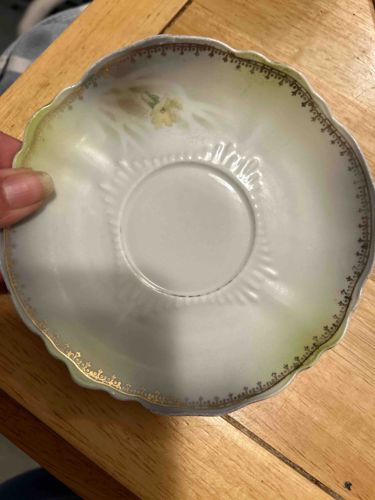
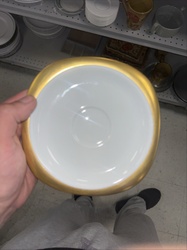
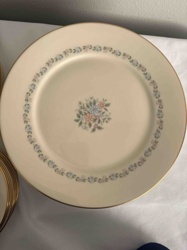
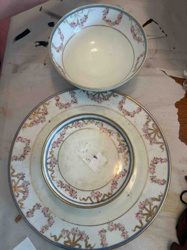
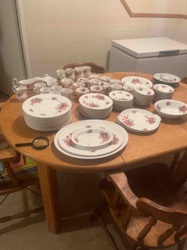
The item is a porcelain saucer, likely part of a teacup or demitasse set, characterized by its delicate craftsmanship and ornate decoration. Physically, it is a small, circularly shaped dish with a raised central ring designed to cradle a cup, preventing it from sliding. The rim of the saucer features a scalloped or fluted edge, adding to its elegant appearance rather than a plain, smooth circumference. The primary color of the porcelain is a soft, off-white or cream, which transitions subtly into a pale chartreuse or yellowish-green hue around the outer edge, creating a gentle ombre effect. Adorning the green-tinted area are hand-painted floral motifs, specifically delicate blossoms that appear to be in shades of yellow and light pink or purple, surrounded by faint foliage. The rim is further embellished with a gold-colored band, intricately detailed with a series of small, repeating patterns such as dots and dashes, or a stylized scrollwork, indicative of a high level of decorative artistry. The central cup ring and the raised fluting around it are visible, suggesting a molded construction for functional support and aesthetic appeal. Given the style of decoration, including the hand-painted florals and gold accents, this saucer likely dates from the late 19th to early 20th century, possibly of European origin (e.g., German, Austrian, or French porcelain manufacturers were known for such wares). There are no visible chips, cracks, or significant abrasions from the provided image, though some wear to the gold trim or slight fading of the painted details might be present upon closer inspection, typical for an item of its age. The quality of craftsmanship appears to be good, with a refined finish and attention to decorative details, indicating it was likely a higher-end domestic or ornamental item.
AI Appraisal Report
Based on my visual examination of the image provided, this antique hand-painted porcelain saucer is a charming piece. Its delicate craftsmanship, scalloped rim, and hand-painted floral motifs with gold trim suggest a probable origin in the late 19th to early 20th century, consistent with European porcelain manufacturers. The soft off-white transitioning to a pale chartreuse and the intricate gold band speak to a high level of decorative artistry. From the image, the condition appears excellent with no visible chips, cracks, or significant abrasions. However, a full in-person examination would be crucial to detect any subtle wear to the gold trim, fading of the painted details, or surface scratches typical of an item of this age.
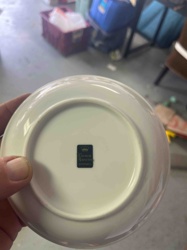
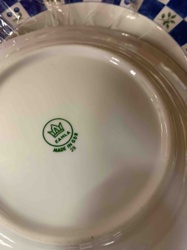
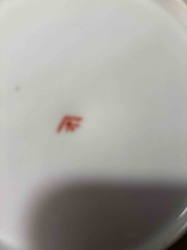
In terms of market conditions, similar hand-painted porcelain saucers, especially those from reputable European manufacturers, generally find a steady demand among collectors of antique dinnerware and decorative arts. While individual saucers are less sought after than complete sets, the apparent quality of this piece enhances its appeal. Its rarity as a standalone item is moderate; while its specific design may be unique, other similar period pieces exist. The lack of visible maker's marks is a significant limitation, as a known manufacturer would considerably increase its value.
For full authentication and a more precise valuation, I would require a physical inspection to check for maker's marks, assess the true condition of the materials, and verify the painting technique. Provenance documentation, if available, would also be invaluable. Without these, this appraisal assumes it is an unmarked but authentic period piece.
Taking these factors into account, including its attractive aesthetics and apparent good condition, but acknowledging the limitations of image-only appraisal and the absence of a visible maker's mark, I would place its current market value conservatively.