AI estimate as of July 26, 2025 · verify with a professional before acting
AI-Generated · Verify before acting
Everything on this page is generated by AI for informational purposes only. AI can make mistakes — the AI may misidentify items or misattribute them (artist, maker, brand, designer, origin, era). This is not an official valuation and should not be used for insurance, sale, tax, estate, legal, or lending purposes — or any decision requiring a certified appraisal. It is not an authoritative claim about any person, brand, or rights holder — do not share or rely on it as a factual statement about a third party. Always consult qualified professionals before making financial decisions.
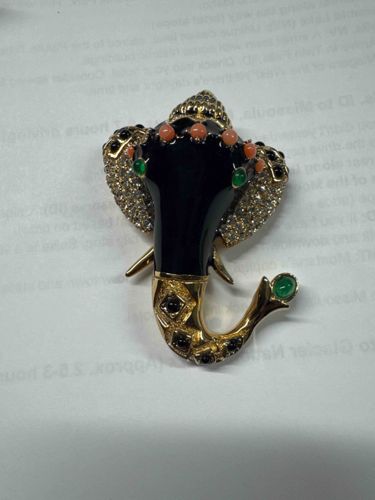
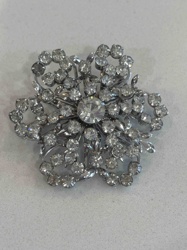
This exquisite piece is a vintage figural brooch, designed in the likeness of a stylized elephant head, likely representing the Hindu deity Ganesha, given its decorative and ornate appearance. The central body of the elephant's head and trunk is rendered in a smooth, polished black enamel, providing a stark contrast to the surrounding elements. The large ears are heavily encrusted with clear, brilliant-cut rhinestones or simulated diamonds set in a pavé style, giving them a rich, sparkly texture and suggesting a gold-tone metal base. Along the upper edge of the black enamel head, a series of cabochon-cut stones alternate, with an orangey-pink color (possibly coral or glass) and a vibrant green (likely emerald-colored glass or simulated emeralds), adding splashes of color. Two of these green stones are prominently featured on either side of the trunk near the eyes, acting as the eyes themselves. The trunk curls upwards, terminating in a single, larger cabochon green stone, mirroring the color of the 'eyes.' The lower portion of the brooch, resembling the elephant's tusks or lower jawline, is crafted from the same gold-tone metal, featuring an intricate textured pattern and set with small black stones, possibly black enamel or onyx/glass, creating a checkered or diamond-like motif. The craftsmanship appears to be of good quality, with secure stone settings and a well-preserved enamel finish. There are no readily visible marks, signatures, or obvious condition issues like chips or significant wear to the enamel or metal from the provided images, indicating good preservation. Given the materials and style, it likely dates from the mid-20th century, possibly 1950s-1970s, a popular period for figural costume jewelry.
AI Appraisal Report
Based on my visual examination of the provided image, this Ganesha-inspired elephant head brooch appears to be in very good vintage condition. The black enamel shows no visible chips or significant wear, and the pave-set rhinestones in the ears appear intact and brilliant. The cabochon stones, both the orangey-pink and green, are present and add vibrant color. The gold-tone metal, particularly the intricately textured lower portion, also seems well-preserved with no obvious signs of pitting or heavy tarnish.
This piece is a classic example of figural costume jewelry, likely dating from the mid-20th century (1950s-1970s). The design, materials (rhinestones, various cabochon substitutes for precious stones, and base metal), and probable construction suggest it's a mass-produced, yet good quality, costume piece rather than fine jewelry. The Ganesha-inspired motif is appealing and contributes to its desirability.
Market conditions for vintage costume jewelry remain robust, especially for figural pieces in excellent condition and with unique designs. Comparable sales for well-preserved, ornate figural brooches of this era by unconfirmed or unsigned makers typically range from $75 to $200, depending on design appeal and condition. Pieces with a clear designer signature (e.g., Boucher, Trifari, Coro) would command significantly higher prices, but no such marks are visible here.
Its rarity is moderate; while not unique, finding pieces in this specific design and condition is not commonplace. The demand is driven by collectors of vintage costume jewelry and those seeking unique, attractive accessories. Factors positively impacting value include the excellent condition, the appealing Ganesha motif, and the intricate detailing. Without visible maker's marks or provenance, attributing it to a specific designer is impossible, limiting its top-tier collecting value.
Limitations: My assessment of authenticity and materials is based solely on visual inspection of the image. A physical examination would be necessary to confirm the materials (e.g., type of metal, whether stones are glass, plastic, or natural, or simulated), verify the absence of hidden signatures, and assess the true condition of pin mechanisms or any subtle wear not visible in photographs. Scientific testing (e.g., XRF for metal composition) would be required for definitive material identification. Provenance documentation, if available, could significantly enhance its value by linking it to a specific maker or collection.