AI identification & appraisal estimate

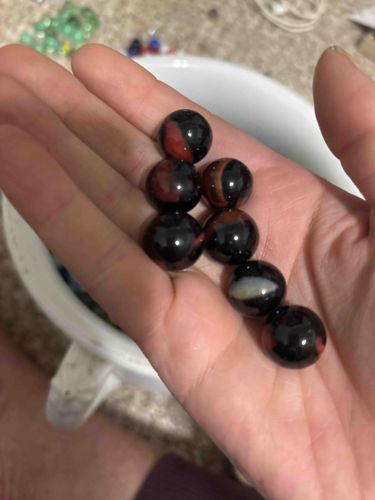
Assorted Vintage Glass Marbles (Devil's Eye/Cat's Eye style)

Submitted photo of Assorted Vintage Glass Marbles (Devil's Eye/Cat's Eye style)
Photo submitted by the user — not generated by AI

User's notes

Vintage marbles

These notes were written by the person who submitted this item. Appraiser.AI has not verified them, and the AI's identification and estimate may rely on them.

AI Estimated Value

Not an official valuation

$5-15

AI estimate as of July 31, 2025 · verify with a professional before acting

AI-Generated · Verify before acting

Everything on this page is generated by AI for informational purposes only. AI can make mistakes — the AI may misidentify items or misattribute them (artist, maker, brand, designer, origin, era). This is not an official valuation and should not be used for insurance, sale, tax, estate, legal, or lending purposes — or any decision requiring a certified appraisal. It is not an authoritative claim about any person, brand, or rights holder — do not share or rely on it as a factual statement about a third party. Always consult qualified professionals before making financial decisions.

This analysis also relies on unverified notes provided by the user, which may be incomplete or inaccurate and could affect the result.

Read the full disclaimer

AI Item Analysis

This image features a collection of approximately eight vintage glass marbles held in an open palm. The marbles are predominantly dark, appearing black or very deep brown, with vibrant streaks of color. Several marbles exhibit striking red or reddish-brown swirls, typical of 'Devil's Eye' or 'Dragon's Eye' style marbles. One notable marble has a distinct, elongated, somewhat opaque white or cream-colored swirl against its dark body, possibly indicating a 'Cat's Eye' or similar design. All marbles appear to be spherical and made of glass, consistent with classic marble manufacturing. Their surfaces are glossy, suggesting good preservation; however, minor scuffs, nicks, or scratches, common with vintage playthings, may be present upon closer inspection, though not clearly discernible from the provided image. The consistency in size among the visible marbles suggests they were likely manufactured as a set or for common play. The presence of varied internal patterns, such as the swirling colors and distinct bands, indicates a machine-made construction, common in the mid-to-late 20th century. Their uniform size, typically around 5/8 to 3/4 inch in diameter (shooter or player size), further supports this. The craftsmanship appears to be of standard quality for mass-produced marbles, with good clarity in the glass and distinct coloration. The 'vintage' context provided suggests these marbles are not newly manufactured but have some age, contributing to their collectible appeal.
AI Appraisal Report

Upon examining the image of this collection of approximately eight vintage glass marbles, I have assessed them to be mass-produced, machine-made examples from the mid-to-late 20th century. The marbles present as being in good, played-with condition, showing a glossy surface typical of well-preserved glass. The designs, featuring dark bodies with vibrant red swirls ('Devil's Eye' or 'Dragon's Eye') and one with an opaque white swirl ('Cat's Eye'), are common for this era. The collector's market for common, machine-made marbles is generally modest. While specific rare color combinations or manufacturers can command higher prices, these appear to be standard examples. Their value lies primarily in their nostalgic appeal and condition. Based on recent sales of similar small lots of vintage machine-made marbles on online marketplaces and at collector shows, the demand is steady but the supply is plentiful. Key factors influencing this appraisal are the common nature of the marble types and the small lot size. More unique, handmade marbles from earlier periods, or those from sought-after manufacturers like Akro Agate or Christensen, would fetch significantly higher prices. A definitive valuation is limited by the inability to physically inspect the items. An in-person examination is necessary to check for subtle 'hit' marks, chips, or scuffs that would detract from the value. Furthermore, a physical inspection would allow for precise measurement and identification of seams or pontil marks that could help pinpoint the manufacturer, which is crucial for a more accurate appraisal.

Keep exploring

More toys/collectibles appraisals

Get your items appraised

Instant AI-powered appraisal estimates from a photo

Browse More Appraisals