AI estimate as of September 30, 2025 · verify with a professional before acting
AI-Generated · Verify before acting
Everything on this page is generated by AI for informational purposes only. AI can make mistakes — the AI may misidentify items or misattribute them (artist, maker, brand, designer, origin, era). This is not an official valuation and should not be used for insurance, sale, tax, estate, legal, or lending purposes — or any decision requiring a certified appraisal. It is not an authoritative claim about any person, brand, or rights holder — do not share or rely on it as a factual statement about a third party. Always consult qualified professionals before making financial decisions.
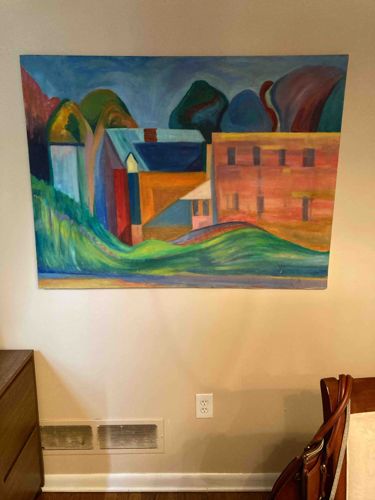
This item is an unframed, large-scale abstract painting, executed in a style reminiscent of Cubism or Fauvism, depicting a vibrant landscape with architectural elements. The physical characteristics indicate it is likely an oil or acrylic on canvas, given the texture and saturation of the colors. The color palette is bold and expressive, featuring dominant hues of blues, greens, reds, oranges, and earthy tones. The sky is rendered in varying shades of blue, transitioning from lighter to darker at the top, suggesting depth. Hilly or mountainous terrain is depicted with undulating forms in shades of green, brown, and reddish-purple, creating a sense of movement and depth. Several buildings are integrated into the landscape, characterized by geometric shapes and planes of contrasting colors. One prominent building on the right is a reddish-orange brick-like structure with simplified, rectangular windows. Another cluster of buildings to the left features steep gabled roofs in blues and greens, with walls in reds, oranges, and light blues. The construction appears to be a traditional stretched canvas, though the edges are not visible all around to confirm the presence of a stretcher bar. No visible frame is present, suggesting it is either intended to be unframed or the frame has been removed. The overall condition appears good, with no obvious tears, punctures, or significant paint loss visible from the provided image. There are no clear markings or signatures discernible in the provided images, which would be crucial for artist identification and dating. The style suggests a 20th or 21st-century origin, drawing inspiration from early modernist movements, perhaps dating from the mid-to-late 20th century or contemporary. The brushwork, though not extremely detailed, conveys a sense of dynamism. The vibrancy of the colors and the strong compositional lines indicate a work with artistic intent and a certain level of craftsmanship.
AI Appraisal Report
I have examined the provided image of this large-scale abstract painting, which depicts a vibrant landscape with architectural elements, executed in a style reminiscent of Cubism or Fauvism. The physical characteristics, including the textured appearance and saturated colors, strongly suggest it is an oil or acrylic on canvas. The color palette is bold and expressive, dominated by blues, greens, reds, oranges, and earthy tones, creating a dynamic composition. The overall condition appears good, with no obvious signs of tears, punctures, or significant paint loss visible from the image. The brushwork conveys dynamism, and the vibrancy of colors indicates artistic intent.
Regarding authenticity, due to the absence of clear markings or signatures and the lack of provenance documentation, definitive attribution to a specific artist or concrete dating is not possible from the image alone. This significantly impacts its market value. The style points to a 20th or 21st-century origin, likely drawing inspiration from early modernist movements, possibly mid-to-late 20th century or contemporary.
In terms of market conditions, paintings by unidentified artists, even with strong aesthetic appeal and good condition, typically command lower prices than works with established provenance. Comparables for unsigned, decorative abstract landscapes in a similar style by unknown artists would place this piece in the general decorative art market. Demand exists for such pieces for interior design purposes, but rarity is low given the prevalence of works inspired by these movements.
Factors significantly impacting value include the lack of artist identification and the absence of a visible frame. To fully authenticate and maximize value, an in-person examination would be crucial to inspect the painting's support (canvas type, stretcher bars), verify the paint medium, look for faint hidden signatures, and assess the overall craftsmanship in detail. Provenance documentation, such as exhibition history or previous ownership, would be vital for any significant increase in value. Scientific testing (e.g., pigment analysis, carbon dating of canvas) could help narrow down its age, but is often cost-prohibitive for pieces in this category.