AI estimate as of October 29, 2025 · verify with a professional before acting
AI-Generated · Verify before acting
Everything on this page is generated by AI for informational purposes only. AI can make mistakes — the AI may misidentify items or misattribute them (artist, maker, brand, designer, origin, era). This is not an official valuation and should not be used for insurance, sale, tax, estate, legal, or lending purposes — or any decision requiring a certified appraisal. It is not an authoritative claim about any person, brand, or rights holder — do not share or rely on it as a factual statement about a third party. Always consult qualified professionals before making financial decisions.
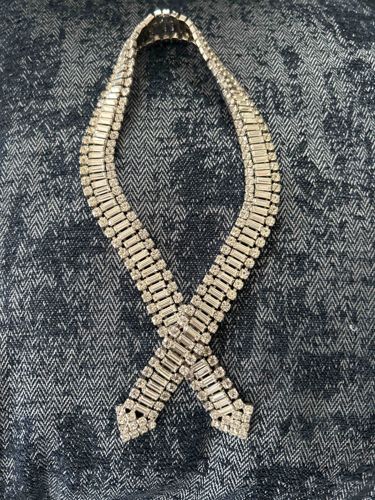
This item is a dazzling rhinestone choker necklace, meticulously designed to create a brilliant, continuous sparkle. The necklace is constructed from a silver-toned metal, likely a base metal alloy, that is studded with numerous clear paste rhinestones. The design features multiple parallel rows of rectangular baguette-cut rhinestones flanked by smaller, round-cut rhinestones, creating a rich texture and reflective surface. The overall construction appears to be flexible, allowing it to conform comfortably around the neck. The necklace tapers slightly towards the ends, which are finished with an arrow or pointed motif, fully encrusted with round rhinestones. While specific dimensions are not discernible from the image, it appears to be a choker style, designed to sit high on the neck. The condition appears to be good, with all rhinestones present and intact, exhibiting a uniform sparkle without noticeable dullness or discoloration. There are no visible signs of significant wear, missing stones, or repairs. The silver-toned metal maintains its luster, indicating good preservation. Due to its style and materials, it likely dates from the mid-20th century, possibly the 1940s to 1960s, a period known for its glamorous costume jewelry. There are no visible maker's marks or signatures in the provided crop. The craftsmanship indicates a mass-produced but well-executed piece of costume jewelry designed for formal wear or special occasions.
AI Appraisal Report
Based on my visual examination of the provided image, this rhinestone choker necklace appears to be in good to very good condition. All rhinestones are present, intact, and exhibit a consistent sparkle, indicating no significant dullness or discoloration. The silver-toned base metal also retains its luster, with no apparent tarnish or wear. The construction suggests a mass-produced costume jewelry piece from the mid-20th century, likely dating from the 1940s to 1960s, a period when such glamorous designs were popular for formal wear.
Authenticity is limited to visual assessment from the image. Without a physical in-hand examination, I cannot confirm the exact material composition of the 'silver-toned metal' or the rhinestones. True authenticity verification would require in-person inspection to assess the weight, craftsmanship quality, and potential presence of hidden maker's marks, as well as testing of the metal composition. Provenance documentation, if available, would also be crucial.
Market conditions for vintage costume jewelry of this type are generally stable, though not exceptionally high. Similar rhinestone chokers, especially unmarked pieces, typically fall into an accessible price range. Comparables on platforms like Etsy, eBay, and specialty vintage jewelry sites suggest a value range for well-preserved, unmarked rhinestone chokers. Demand is moderate, driven by collectors of vintage costume jewelry and individuals seeking unique accessories for special occasions. Rarity is low, as these types of pieces were mass-produced. The lack of a discernible maker's mark significantly impacts value, as signed pieces by renowned costume jewelry designers command substantially higher prices. The good condition is the primary factor supporting its value within the estimated range. Factors that would enhance value include superior craftsmanship, a known designer, or a unique design element that sets it apart from typical mass-market items.