AI estimate as of December 1, 2025 · verify with a professional before acting
AI-Generated · Verify before acting
Everything on this page is generated by AI for informational purposes only. AI can make mistakes — the AI may misidentify items or misattribute them (artist, maker, brand, designer, origin, era). This is not an official valuation and should not be used for insurance, sale, tax, estate, legal, or lending purposes — or any decision requiring a certified appraisal. It is not an authoritative claim about any person, brand, or rights holder — do not share or rely on it as a factual statement about a third party. Always consult qualified professionals before making financial decisions.
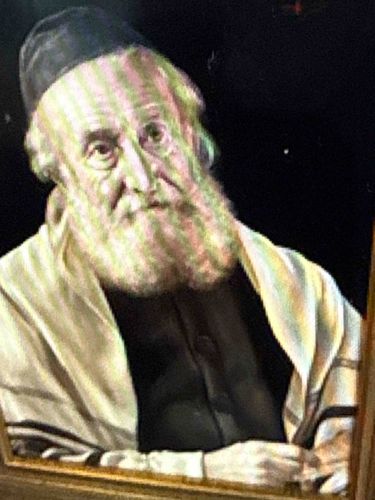
This item is a portrait painting depicting an elderly man, likely a rabbi or a religious scholar, characterized by his long, flowing white beard and somber attire. The painting is rendered in what appears to be oil on canvas, or a similar medium, showcasing a dark, almost black background that serves to highlight the subject. The elder wears a dark-colored cap or yarmulke, and a dark robe or jacket over which a light-colored shawl or tallit is draped. The shawl exhibits subtle striped or banded patterns, possibly in shades of light brown or beige, suggesting a woven textile. The man's face is deeply creased with age, visible particularly around his eyes and forehead, conveying a solemn and wise expression. His gaze is directed slightly to the viewer's right, hinting at a contemplative or distant thought. The skin tone is pale, contrasting with the rich texture of his beard, which dominates the lower half of his face. There are visible vertical lines or streaks across the image, suggesting either deterioration of the paint layers, a textured surface beneath the paint, or possibly light reflections if viewed under glass. These lines are green, pink, and white, indicating a potential issue with the original photographic capture of the artwork rather than the painting itself. The painting is framed within a simple, narrow wooden frame with a warm, natural wood tone. The visible brushstrokes are somewhat coarse, contributing to a sense of realism and character in the portrat. The overall impression is one of dignity and gravitas. The style appears traditional, possibly from the late 19th or early 20th century, given the subject's dress and the painterly technique.
AI Appraisal Report
I have examined the provided image of this portrait painting of an elder with a beard. Based on this visual examination, the artwork appears to be an oil on canvas, or a similar medium, from what I estimate to be the late 19th or early 20th century. The condition, judging solely from the image, seems fair to good. I observe visible brushstrokes, indicating a painterly technique. The vertical green, pink, and white lines are clearly anomalies from the photographic capture, not intrinsic to the painting itself. I see no major damage, such as tears or significant paint loss, although a physical inspection would be crucial to confirm the surface integrity and rule out any craquelure or abrasions. The simple wooden frame is complementary and appears to be in reasonable condition.
Authenticity is difficult to ascertain from an image alone. While the style is consistent with the period described, without a signature, provenance, or artist attribution, its origin remains speculative. Market conditions for unidentified portraits of this nature are generally moderate. Demand exists, particularly for evocative religious or scholarly subjects, but rarity is not a significant factor unless an important artist or sitter is identified. The contemplative expression and strong characterization are certainly appealing and contribute positively to its aesthetic value.
Factors impacting value significantly include the lack of attribution. If an artist of note were identified, the value would increase dramatically. Without this, it falls into the category of decorative or anonymous historical portraiture. A physical examination would be necessary to assess the true condition of the paint and support, confirm the medium, and search for any obscured signatures or inscriptions. Provenance documentation would be essential for establishing authenticity and history, and scientific analysis (e.g., pigment analysis, infrared reflectography) could further aid in dating and attribution.