These notes were written by the person who submitted this item. Appraiser.AI has not verified them, and the AI's identification and estimate may rely on them.
AI Estimated Value
Not an official valuation
$20-30
AI estimate as of July 6, 2025 · verify with a professional before acting
AI-Generated · Verify before acting
Everything on this page is generated by AI for informational purposes only. AI can make mistakes — the AI may misidentify items or misattribute them (artist, maker, brand, designer, origin, era). This is not an official valuation and should not be used for insurance, sale, tax, estate, legal, or lending purposes — or any decision requiring a certified appraisal. It is not an authoritative claim about any person, brand, or rights holder — do not share or rely on it as a factual statement about a third party. Always consult qualified professionals before making financial decisions.
This analysis also relies on unverified notes provided by the user, which may be incomplete or inaccurate and could affect the result.
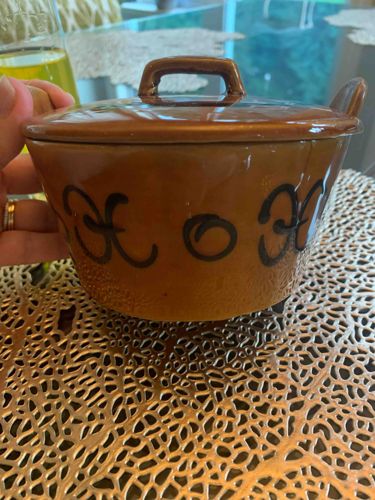
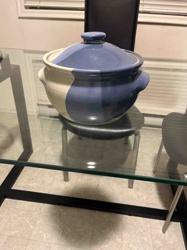
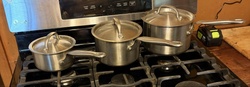
This item is a small, lidded casserole dish, likely intended for individual servings or small portions. It is crafted from ceramic or earthenware, finished with a glossy, rich brown glaze that gives it a warm, inviting appearance. The pot features a rounded, shallow bowl shape, broader at the rim and tapering slightly towards the base. The exterior is decorated with abstract, hand-painted black swirl or floral-like motifs, arranged symmetrically around the circumference, adding a touch of rustic charm. A matching brown lid covers the vessel, topped with a rectangular, loop-style handle for easy removal. On one side of the lid, there is a small, raised tab or handle, possibly for aeration or specific pouring/handling. The overall construction appears sturdy and utilitarian. The glaze shows some areas of lighter brown or possibly minor wear, particularly around the rims and handles, consistent with age and use. No significant chips, cracks, or repairs are immediately visible. The craftsmanship suggests it is a mass-produced item, though the hand-painted decoration adds a unique element to each piece. Without maker's marks, precise manufacturing details or age are difficult to ascertain, but its style is reminiscent of mid-20th century kitchenware, possibly from the 1950s-1970s, often produced as part of casual dinnerware sets or bakeware collections.
AI Appraisal Report
Upon examining the provided image and description of this small, lidded ceramic casserole dish, I assess its condition as good vintage. The glossy rich brown glaze appears largely intact, with expected minor wear and lighter areas around rims and handles, consistent with its likely age and use. Crucially, I see no immediate signs of significant chips, cracks, or repairs, which is excellent for an item of this type. The hand-painted abstract motifs add a unique touch, although the overall form suggests a mass-produced origin. Without maker's marks, definitive authenticity regarding the exact manufacturer or origin is limited to visual style, placing it likely in the mid-20th century (1950s-1970s).
In terms of market conditions, vintage earthenware casserole dishes of this size and style are generally common. They are sought after by collectors of vintage kitchenware and those looking for rustic or retro home decor. Demand is moderate, but rarity is low for unmarked, mass-produced pieces. Factors impacting value include its good condition, the appealing hand-painted decoration, and its charming utilitarian aesthetic. However, the lack of a known maker or specific provenance, coupled with its commonality, prevents it from commanding a high price. Competitive comparables from online marketplaces for similar unmarked vintage ceramic casserole dishes in good condition typically range from $15 to $30.
For full authentication, especially if a specific maker or origin were claimed, an in-person examination would be necessary to check for subtle marks, specific glaze characteristics, and craftsmanship details not visible in images. Provenance documentation (e.g., original sales receipts, family history) could also confirm its age and origin. Scientific testing for material composition is unlikely to be cost-effective or necessary given the nature of the item.