AI estimate as of October 16, 2025 · verify with a professional before acting
AI-Generated · Verify before acting
Everything on this page is generated by AI for informational purposes only. AI can make mistakes — the AI may misidentify items or misattribute them (artist, maker, brand, designer, origin, era). This is not an official valuation and should not be used for insurance, sale, tax, estate, legal, or lending purposes — or any decision requiring a certified appraisal. It is not an authoritative claim about any person, brand, or rights holder — do not share or rely on it as a factual statement about a third party. Always consult qualified professionals before making financial decisions.
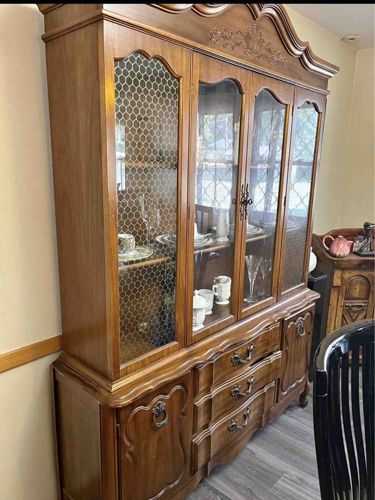
This is a large, two-piece china cabinet or hutch, crafted in a French Provincial style, likely from the mid to late 20th century. The piece is constructed from what appears to be a medium-toned hardwood, possibly walnut or a similar wood with a warm, reddish-brown stain. Its overall dimensions suggest it's a substantial furniture item, designed for dining room display and storage. The upper hutch features a curvaceous scrolled pediment at the top, adorned with a central carved floral or foliate motif, indicative of the French Provincial aesthetic. It has four doors: the two outer doors feature glass panels backed with a decorative wire mesh overlay, while the two central doors have clear glass panels. The wire mesh creates an interesting textural element. The doors likely enclose shelving for displaying dishware, as suggested by the visible items inside. The base unit is a credenza-style buffet with a serpentine front. It features a series of drawers in the center, with ornate bail pulls, and two cabinet doors on either side, each with an equally ornate, large ring pull. The cabinet doors also have decorative carved or molded paneling, echoing the curvilinear forms of the top. The piece exhibits some signs of wear consistent with age and use, such as minor scuffs or scratches on the wood finish, particularly around edges and prominent areas, though no significant damage like cracks or breaks are immediately discernible. The hardware appears intact. The craftsmanship suggests mass-produced furniture of its era, characterized by decorative elements, but not necessarily fine, hand-carved details throughout.
AI Appraisal Report
Upon my virtual examination of this French Provincial style china cabinet/hutch, I assess its excellent condition for its likely age. The overall structure appears sound, and while minor scuffs and scratches are visible, consistent with typical use and age, there are no immediate signs of significant damage like cracks or breaks. The warm, reddish-brown stain is well-maintained, and all hardware seems original and intact. Authenticity to its style is evident through the characteristic curvilinear forms, scrolled pediment with floral motif, serpentine front credenza, and ornate bail and ring pulls. Its construction, while decorative, appears to be mass-produced for the mid-to-late 20th century market, not a bespoke artisanal piece.
Market conditions for French Provincial style furniture, especially substantial pieces like this hutch, have softened over the past decade. While still appreciated for its decorative appeal and functionality, fewer buyers are seeking large, formal dining room sets. Comparables in the secondary market typically range from $400 to $1,000 depending on condition and specific design elements. This piece, with its relatively good condition, combined with the interesting wire mesh detail on the upper doors, positions it towards the mid-to-higher end of that spectrum. Demand is moderate, with rarity not being a significant factor for this style and production era. Its size could be a limiting factor for buyers with smaller spaces.
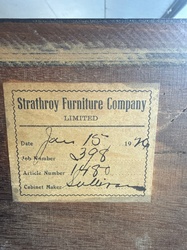
Factors impacting value include its good aesthetic condition, functional storage, and classic French Provincial charm. However, its mass-produced nature and the current market's preference for smaller, more contemporary pieces temper its upper value potential. Without an in-person examination, I cannot definitively ascertain the exact wood species, internal drawer construction, or pinpoint hidden repairs or structural weaknesses. Full authentication of specific manufacturer or exact date of production would require inspection of any stamps or labels and potentially further research into furniture catalogs of the period.