AI identification & appraisal estimate

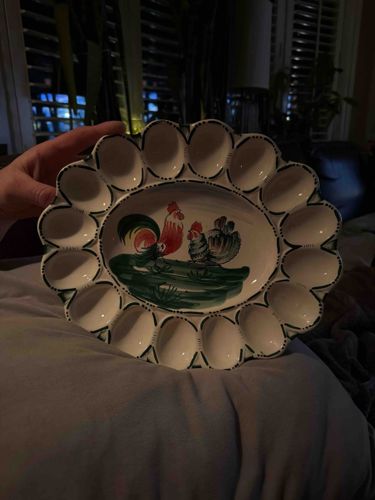
Hand-Painted Italian Majolica Deviled Egg Platter with Rooster Motif

Submitted photo of Hand-Painted Italian Majolica Deviled Egg Platter with Rooster Motif
Photo submitted by the user — not generated by AI

User's notes

Excellent condition- hand painted from Italy

These notes were written by the person who submitted this item. Appraiser.AI has not verified them, and the AI's identification and estimate may rely on them.

AI Estimated Value

Not an official valuation

$35 - $65

AI estimate as of March 2, 2026 · verify with a professional before acting

AI-Generated · Verify before acting

Everything on this page is generated by AI for informational purposes only. AI can make mistakes — the AI may misidentify items or misattribute them (artist, maker, brand, designer, origin, era). This is not an official valuation and should not be used for insurance, sale, tax, estate, legal, or lending purposes — or any decision requiring a certified appraisal. It is not an authoritative claim about any person, brand, or rights holder — do not share or rely on it as a factual statement about a third party. Always consult qualified professionals before making financial decisions.

This analysis also relies on unverified notes provided by the user, which may be incomplete or inaccurate and could affect the result.

Read the full disclaimer

AI Item Analysis

This is a vintage-style decorative and functional oval egg platter, handcrafted in Italy. The piece is constructed from ceramic, likely earthenware with a white tin-glaze characteristic of traditional Majolica. Structurally, the platter features a central recessed oval well surrounded by twelve individual scalloped indentations designed to hold deviled eggs. The central basin is adorned with a charming, hand-painted scene featuring a rooster and a hen standing in a green landscape. The palette includes vibrant reds, deep greens, and greys, applied with visible, expressive brushstrokes that signify manual artistry. The perimeter of each egg slot is accented with a delicate, dark green dotted trim, providing a scalloped visual rhythm to the edge. Given its 'Excellent condition' context, the glaze appears glossy and intact with no visible chips, cracks, or heavy crazing often found in older ceramics. The style is mid-to-late 20th-century Italian folk art, reflecting the rustic charm of regions like Deruta or Tuscany. The craftsmanship exhibits typical artisanal variations, where slight asymmetries in the hand-painted dots and animal figures add to its unique character. Its scalloped outer rim and specific utility make it a specialty piece of serveware.
AI Appraisal Report

Based on my visual examination of the provided images, I have appraised this Hand-Painted Italian Majolica Deviled Egg Platter featuring a rooster motif. The piece exhibits the classic characteristics of Italian export pottery, likely produced in the mid-to-late 20th century. The 'Galletto' (rooster) pattern is a staple of Italian ceramics, particularly from the regions of Deruta or Umbria, symbolizing good fortune and prosperity. The condition appears consistent with the owner's description of 'excellent.' The glaze retains a high gloss, and I observe no obvious chips, hairline fractures, or significant crazing in the photos provided. The hand-painted brushwork is lively and typical of the 'folk art' style intended for the American market. However, without physically handling the item, I cannot inspect the underside for specific maker's marks (such as a 'Made in Italy' stamp or a specific workshop signature like 'Deruta'), which is crucial for pinpointing the exact origin. In the current secondary market, there is a consistent but modest demand for Italian country-style kitchenware. While these pieces are charming and functional, they are relatively common. Comparable sales for similar unsigned or generic signed Italian egg platters typically fall within the $35 to $65 range. If this piece bore the mark of a prestigious workshop (such as Grazia or Solimene), the value would trend higher. Authentication is limited to visual style analysis; full verification would require an in-person inspection of the clay body weight and base markings.

Keep exploring

More kitchen & dining / ceramic serveware appraisals

Get your items appraised

Instant AI-powered appraisal estimates from a photo

Browse More Appraisals