AI estimate as of September 11, 2025 · verify with a professional before acting
AI-Generated · Verify before acting
Everything on this page is generated by AI for informational purposes only. AI can make mistakes — the AI may misidentify items or misattribute them (artist, maker, brand, designer, origin, era). This is not an official valuation and should not be used for insurance, sale, tax, estate, legal, or lending purposes — or any decision requiring a certified appraisal. It is not an authoritative claim about any person, brand, or rights holder — do not share or rely on it as a factual statement about a third party. Always consult qualified professionals before making financial decisions.
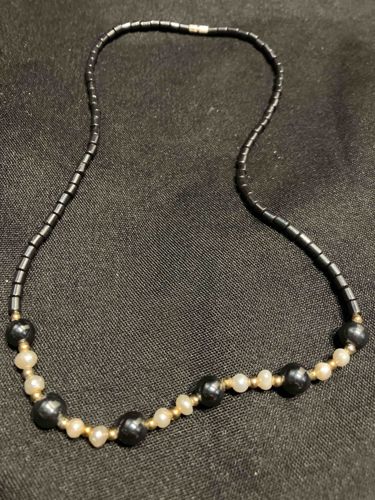
This item is a beaded necklace featuring a combination of lustrous black beads, irregular white pearls, and small, dark cylindrical hematite beads. The necklace is approximately choker length or a slightly longer princess length, designed to sit prominently around the neck. The upper portion of the necklace, extending around the back of the neck, consists solely of uniform, polished, dark grey or black cylindrical hematite beads, strung together to create a flexible chain. These hematite beads appear to be consistent in size and shape. The focal point of the necklace, positioned at the front, is a section where the cylindrical hematite beads transition into a sequence of larger, rounded black beads, alternating with smaller, irregularly shaped white pearls. Separating each of these larger beads and pearls are small, rounded gold-toned spacer beads, adding a touch of warmth and division within the design. The black beads are smooth and spherical with a high polish, reflecting light. The white pearls exhibit natural variations in shape and surface, characteristic of baroque or freshwater pearls, and possess a soft, creamy luster. The clasp, visible at the back of the neck, appears to be a small, possibly magnetic, silver-toned closure. The overall condition appears good with no obvious signs of breakage or significant damage to the beads or stringing. The craftsmanship suggests a commercially produced piece, likely from the late 20th or early 21st century, designed for everyday wear or as a casual accessory.
AI Appraisal Report
Based on my visual examination of the provided image, this Beaded Pearl and Hematite Necklace appears to be in good overall condition. There are no obvious signs of breakage, chips, or significant wear on the beads or the stringing. The polish on the hematite and black beads is consistent, and the pearls retain their natural luster. Authenticity, based solely on visual cues, suggests a commercially produced piece. The uniformity of the hematite and polished black beads, coupled with the irregular but likely cultured freshwater pearls, points to a mass-produced or artisan-crafted item rather than a high-end, bespoke piece. \n\nThe market for similar beaded necklaces, particularly those combining common materials like hematite and freshwater pearls, is quite broad and competitive. Comparable items can be found in a wide range of retail settings, from artisan markets to online jewelry platforms. Demand for such pieces is generally moderate, driven by fashion trends and the versatility for everyday wear. There is no indication of significant rarity; the materials themselves are not rare, and the design, while attractive, is not unique enough to command a premium based on rarity. \n\nFactors impacting value include the non-precious nature of the hematite and the likely cultured freshwater pearls, which typically have a lower value than natural pearls. The gold-toned spacer beads appear to be base metal, not precious metal, further limiting value. The craftsmanship, while neat, does not suggest haute couture. The small silver-toned clasp, possibly magnetic, is functional but not decorative or of high material value. \n\nIt is important to note the limitations of this appraisal due to it being based solely on images. Without physical examination, I cannot definitively determine the exact type, quality, or origin of the pearls (e.g., natural vs. cultured, specific pearl farm), the composition of the black beads (e.g., glass, onyx, plastic), or the exact metal content of the spacer beads and clasp. Scientific testing (e.g., specific gravity tests for hematite/black beads, X-ray diffraction for pearls) and provenance documentation would be necessary for a full authentication and more precise valuation.