AI Appraisal Estimate

AI-generated estimates · not official valuations

From the user

What was submitted

Photo and notes provided by the user — not generated by AI

Submitted item photo
Submitted photo · May 27, 2026

User's notes

No additional notes provided.

AI analysis below

AI appraisal

AI analysis & estimate

AI-Generated · Verify before acting

Everything below is generated by AI for informational purposes only. AI can make mistakes — the AI may misidentify items or misattribute them (artist, maker, brand, designer, origin, era). This is not an official valuation and should not be used for insurance, sale, tax, estate, legal, or lending purposes — or any decision requiring a certified appraisal. It is not an authoritative claim about any person, brand, or rights holder — do not share or rely on it as a factual statement about a third party. Always consult qualified professionals before making financial decisions.

Read the full disclaimer

AI Identification

·Not independently authenticated·Verify before acting

Rococo Revival Pastoral Landscape Painting

Fine Art - Paintings

AI Estimated Value

·Not an official valuation·Verify before acting

$1,000 - $1,500

As of May 27, 2026

AI Item Analysis

·AI can make mistakes·Verify before acting
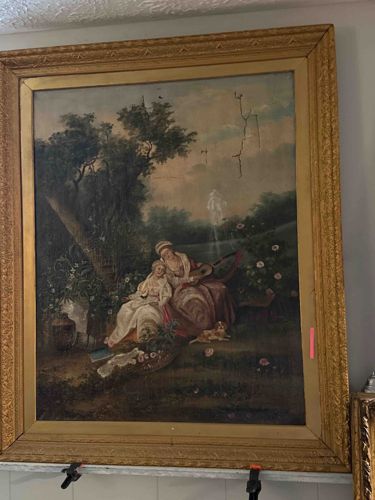
This is a large-scale oil on canvas painting featuring a classic Rococo pastoral scene, set within a period-appropriate gilded frame. The composition depicts two classically elegantly dressed women seated in a lush garden or wooded parkland; one woman appears to be playing a lute or similar stringed instrument while the other reclines against her. At their feet sits a small spaniel-type dog, a common symbol of fidelity in European art. The background consists of tall, dense trees and a soft, hazy sky. The physical construction appears to be oil applied to a canvas support. The color palette is dominated by earthy greens, browns, and muted blues, with the figures highlighted in cream and rose tones. The condition is a primary concern for this piece: there are visible vertical and horizontal cracks in the upper right quadrant of the canvas, suggesting brittle paint or historical impact damage. Visible craquelure is present across the entire surface, and the varnish has likely yellowed with age. The frame is a substantial 19th-century style gilt wood or composition frame with ornate repeating floral and geometric patterns along the outer edge. No clear artist signature is visible in the lower regions of the dark foreground, suggesting it may be the work of a student or a secondary artist following the style of masters like Watteau or Fragonard. The work likely dates to the mid-to-late 19th century as a revival of earlier 18th-century French aesthetics.

AI Appraisal Report

·AI can make mistakes·Verify before acting
Upon examining this large-scale oil on canvas, I identify it as a 19th-century Rococo Revival work, likely of French or perhaps British origin, emulating the 'fête galante' style popularized by Watteau and Fragonard. The subject matter—aristocratic leisure in a pastoral setting—was highly fashionable during the Second Empire and late Victorian eras. The primary factor suppressing the value is condition. As noted in my visual inspection, there is significant structural instability in the upper right quadrant, evidenced by deep vertical and horizontal cracking that suggests canvas trauma or severe shrinkage. The extensive craquelure and darkened, yellowed varnish obscure the original vibrancy of the palette and indicate the piece requires professional conservation, which could exceed the painting's current market value. The absence of a visible signature suggests this is likely the work of a competent decorative artist rather than a listed master. Market demand for unsigned 19th-century revivalist paintings has softened, shifting towards signed works with clearer provenance. Comparable sales for anonymous, large-scale decorative works in 'fair' to 'poor' condition generally fall within the low-to-mid four figures, largely driven by the decorative appeal of the substantial period frame. To provide a definitive authentication or higher valuation, I would require an in-person inspection to view the reverse of the canvas (verso) for stretcher marks or labels, and use UV light to determine the extent of previous overpainting. Without provenance documentation linking this to a specific school or studio, I must value this based on its decorative merit and condition constraints.

Get your items appraised

Instant estimates of your treasures with AI-powered appraisals

Browse More Appraisals