These notes were written by the person who submitted this item. Appraiser.AI has not verified them, and the AI's identification and estimate may rely on them.
AI Estimated Value
Not an official valuation
$25-45
AI estimate as of August 2, 2025 · verify with a professional before acting
AI-Generated · Verify before acting
Everything on this page is generated by AI for informational purposes only. AI can make mistakes — the AI may misidentify items or misattribute them (artist, maker, brand, designer, origin, era). This is not an official valuation and should not be used for insurance, sale, tax, estate, legal, or lending purposes — or any decision requiring a certified appraisal. It is not an authoritative claim about any person, brand, or rights holder — do not share or rely on it as a factual statement about a third party. Always consult qualified professionals before making financial decisions.
This analysis also relies on unverified notes provided by the user, which may be incomplete or inaccurate and could affect the result.
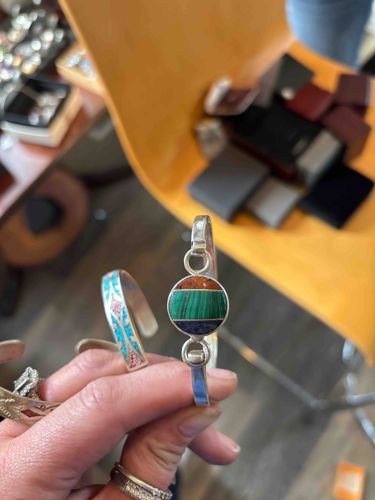
The item is a silver-toned cuff bracelet featuring a central circular inlay of three distinct stones, or possibly fused stone panels. The bracelet itself appears to be made of polished silver or a silver-plated base metal, exhibiting a smooth, reflective surface with a visible, albeit subtle, patina that suggests some age or wear. Its construction is rigid, as expected of a cuff bracelet, with a continuous band that is open at the back for donning. The central design element is a circular bezel-set stone composition. This composition is divided horizontally into three sections. The topmost section is a reddish-brown stone, likely a variety of jasper or carnelian, showing a relatively uniform color. The middle section is a vibrant green stone with prominent parallel banding, characteristic of malachite. The bottom section is a deep blue stone, possibly lapis lazuli or sodalite, with subtle speckles or veining. The inlay appears flush with the metal bezel, indicating a well-executed setting. There are two simple, unadorned silver-toned rings connecting the central circular element to the main bracelet band, one above and one below, adding to the symmetrical design. The overall condition appears good with minor surface scratches consistent with normal use. The craftsmanship of the metalwork seems competent, and the stone inlay is neatly fitted. Without clearer views of potential marks, it's difficult to ascertain specific manufacturing details, but the style, particularly the use of malachite and what appears to be lapis lazuli, often points to a mid-to-late 20th-century aesthetic, possibly Native American or Southwestern style jewelry, though this is not definitively confirmed without maker's marks. The bracelet's quality appears to be that of a mass-produced piece, but not necessarily of low quality, given the clean stone cuts and setting.
AI Appraisal Report
Upon visual examination of the provided images, this silver-toned cuff bracelet presents as a well-crafted piece featuring an inlaid stone composition. The central element, set in a circular bezel, is comprised of three distinct stones: what appears to be red jasper or carnelian, banded malachite, and a deep blue stone consistent with lapis lazuli or sodalite. The metalwork is competent, with a clean setting and polished surface, although it is likely a silver-toned base metal rather than sterling silver, pending a materials test. The overall condition is good, with only minor surface scratches indicative of normal wear.
The style is reminiscent of mid-to-late 20th-century Southwestern jewelry, a popular and accessible market. However, the lack of discernible maker's marks, hallmarks (like 'Sterling' or '.925'), or specific tribal affiliations limits its value to that of a decorative, costume, or fashion piece rather than a collectible artisan item. The presence of an identification number suggests it is a mass-produced item. Market comparables for similar non-sterling, unmarked, multi-stone inlay cuff bracelets typically fall within the lower range. The demand for this style remains steady, but the value is highly dependent on precious metal content and artisan recognition, which are not confirmed here.
It is crucial to note the limitations of an appraisal based on images alone. A definitive authentication requires in-person examination to test the metal's composition (e.g., acid test for silver content) and to professionally identify the stones. Without physical inspection, the 'silver-toned' description, stone identities, and overall authenticity remain assumptions.