AI Appraisal Estimate

AI-generated estimates · not official valuations

From the user

What was submitted

Photo and notes provided by the user — not generated by AI

Submitted item photo
Submitted photo · June 6, 2026

User's notes

Antique painting or print?

AI analysis below

AI appraisal

AI analysis & estimate

AI-Generated · Verify before acting

Everything below is generated by AI for informational purposes only. AI can make mistakes — the AI may misidentify items or misattribute them (artist, maker, brand, designer, origin, era). This is not an official valuation and should not be used for insurance, sale, tax, estate, legal, or lending purposes — or any decision requiring a certified appraisal. It is not an authoritative claim about any person, brand, or rights holder — do not share or rely on it as a factual statement about a third party. Always consult qualified professionals before making financial decisions.

Note

This analysis also relies on unverified notes provided by the user, which may be incomplete or inaccurate and could affect the result.

Read the full disclaimer

AI Identification

·Not independently authenticated·Verify before acting

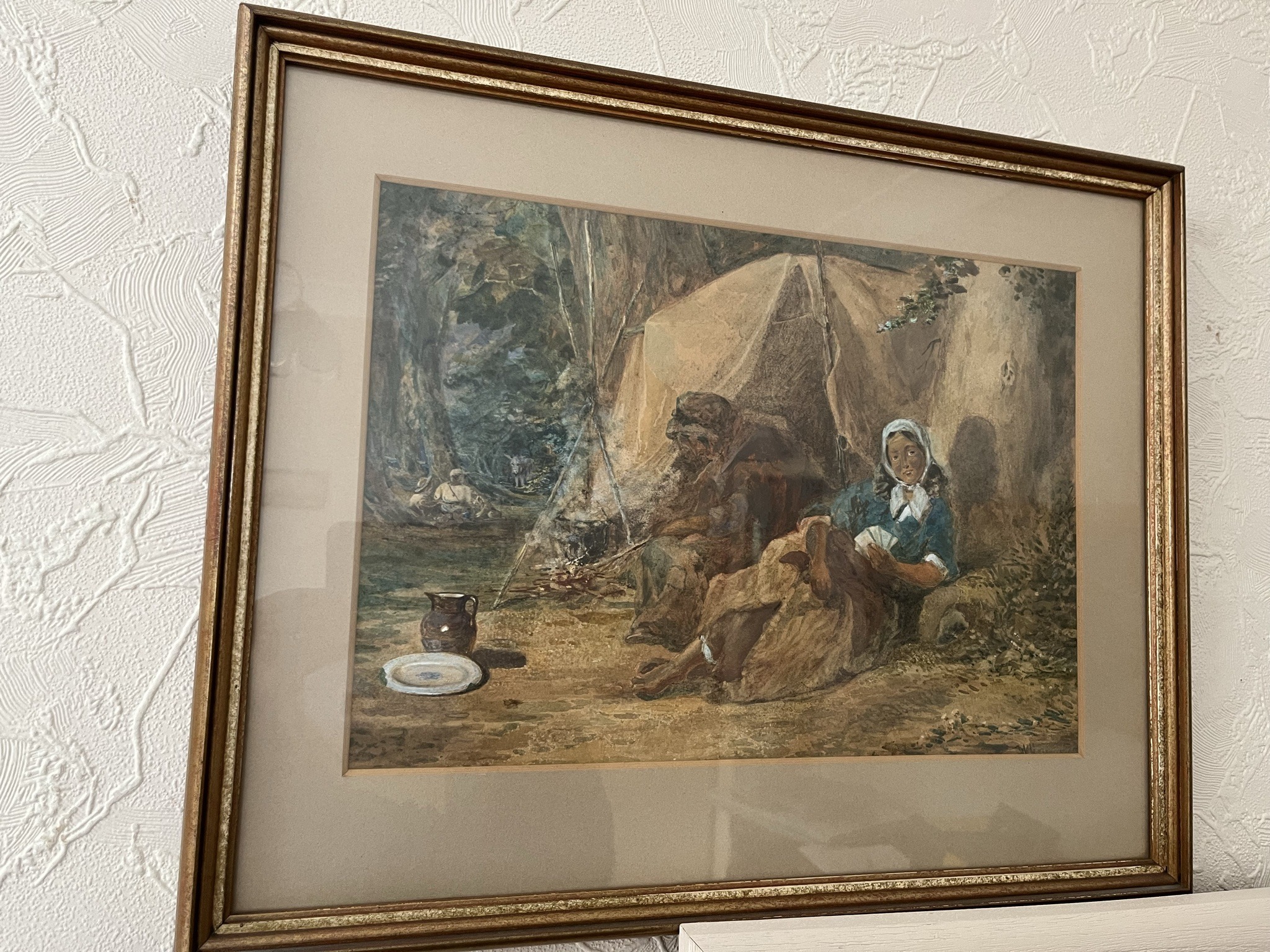
Watercolor Painting of a Gypsy Encampment

Fine Art - Painting

AI Estimated Value

·Not an official valuation·Verify before acting

$450 - $700

As of June 6, 2026

AI Item Analysis

·AI can make mistakes·Verify before acting
This is a 19th-century watercolor and gouache painting on paper, framed under glass. The scene depicts a Romani or 'gypsy' encampment, a popular romanticized theme in Victorian-era British art. Two central figures are featured outside a tent: a woman in a blue bodice and light headscarf holding a deck of cards (suggesting fortune-telling), and a seated man in dark, rustic clothing. The background shows a wooded area with further figures and a cooking pot over an open fire. In the foreground, a detailed still life of a ceramic pitcher and plate is visible. The artistic style is loose and atmospheric, utilizing a palette of earth tones, deep blues, and muted greens. The work is housed in a carved gilt-wood frame with an inner beige matting. There is evidence of foxing (small brown spots) on the paper, particularly in the lighter upper quadrants, and some mild acid-curing or staining from the original wood backing. The frame shows minor surface wear and loss of gilding on the corners, consistent with an age ranging from the mid-to-late 1800s. No signature is immediately visible in the lower corners, which may be covered by the matting. The quality of the anatomical rendering and the light-play indicates a skilled academic painter or a highly proficient amateur of the period.

AI Appraisal Report

·AI can make mistakes·Verify before acting
Based on my examination of the submitted images, I have assessed this 19th-century watercolor and gouache painting. The composition, depicting a romanticized Romani encampment, is a classic example of British Victorian 'Orientalism at home,' a genre heavily popularized by artists like Joshua Cristall or Robert Hills. The technical proficiency in the gouache highlights on the ceramic pitcher and the atmospheric layering of the forest suggests a formally trained artist. However, the presence of foxing and significant acid-mat burn around the edges indicates the work has suffered from its original wood-pulp backing and acidic mounting, which dampens the market value. The market for 'English School' unsigned watercolors remains stable but has cooled significantly from its peak in the late 20th century. Current demand is driven primarily by subject matter and decorative appeal rather than investment potential, unless a signature can be definitively attributed. Comparable sales of unattributed 19th-century watercolors of similar size and condition typically range between $400 and $800 at auction. Critically, a definitive appraisal is limited by the inability to inspect the paper's verso for a signature or watermark, which may be hidden by the current matting. Full authentication would require removing the work from the frame to assess the paper type and check for light-fading under the mat. My current valuation assumes the piece remains unattributed. Should a signature of a known Royal Academy exhibitor be discovered upon removal, the value could increase three to five-fold. For insurance purposes, I recommend a professional de-acidification cleaning to halt the progress of the foxing.

Get your items appraised

Instant estimates of your treasures with AI-powered appraisals

Browse More Appraisals