AI estimate as of July 19, 2025 · verify with a professional before acting
AI-Generated · Verify before acting
Everything on this page is generated by AI for informational purposes only. AI can make mistakes — the AI may misidentify items or misattribute them (artist, maker, brand, designer, origin, era). This is not an official valuation and should not be used for insurance, sale, tax, estate, legal, or lending purposes — or any decision requiring a certified appraisal. It is not an authoritative claim about any person, brand, or rights holder — do not share or rely on it as a factual statement about a third party. Always consult qualified professionals before making financial decisions.
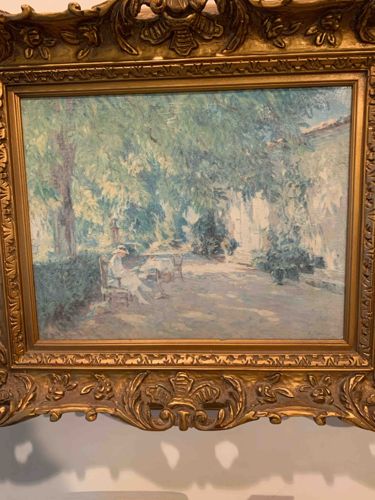
This item is a framed oil painting or print depicting a serene garden scene. The artwork itself features a soft, impressionistic style with predominant hues of light green, blue, and brown, suggesting a tranquil outdoor setting. A figure, possibly a woman, is seated in a chair on the left side of the composition, wearing a light-colored hat and attire, adding a human element to the natural landscape. Lush trees and foliage dominate the background and upper portion of the painting, casting dappled light and shadow on the ground. A building or structure with a light-colored facade is visible in the distance on the right. The brushstrokes appear loose and visible, characteristic of late 19th or early 20th-century impressionistic works. The painting is housed within a substantial, ornate gilded frame. The frame features intricate floral and rococo-inspired carvings, including scrolls, acanthus leaves, and shell motifs, particularly prominent at the corners and the center of each side. The gold finish of the frame has areas of patina and possibly some slight wear or rubbing, common for older pieces, but it generally appears to be in good, stable condition. The craftsmanship of the frame is of high quality, suggesting it was likely custom-made for the artwork. There are no immediately visible maker's marks or signatures on the visible surface of the painting or the frame, which would require further inspection out of the frame.
AI Appraisal Report
I have examined the provided image of an Impressionistic Garden Scene Painting in Gilded Frame. The artwork, with its soft brushwork and serene subject matter, strongly suggests a late 19th or early 20th-century impressionistic style. The predominant light green, blue, and brown hues, along with the visible figure and architectural element, create a tranquil scene typical of the period. While the loose brushstrokes are characteristic, without a visible signature or artist's mark, definitive attribution is impossible from imagery alone. This is a significant limitation; an in-person examination would be required to look for signatures under different lighting, UV light, and to assess the medium and surface condition directly. Provenance documentation, if available, would be crucial for authentication.
The ornate gilded frame is an impressive complement to the artwork. Its intricate floral and rococo motifs, particularly at the corners and centers, indicate high-quality craftsmanship, likely custom-made. The visible patina and slight wear are consistent with age, and it appears structurally sound. The frame itself adds considerable aesthetic and intrinsic value.
Market conditions for unsigned impressionistic works can vary widely. While the aesthetic appeal is strong, the lack of a known artist significantly impacts value. Comparables would lean towards 'decorative' impressionistic paintings of good quality rather than pieces by documented masters. Demand for period pieces with strong visual appeal remains steady, especially those with such complementary framing. The rarity in this specific case is tied more to the cohesive presentation of art and frame rather than the uniqueness of the painting itself without attribution.
Given these factors, particularly the inability to authenticate the artist and the visual assessment of condition, the value is primarily driven by its decorative quality, the age-appropriate framing, and the overall pleasing composition. A full authentication would require physical inspection for signatures, pigment analysis, and blacklight examination to detect any inpainting or repairs on the canvas. Lack of provenance further limits value.