AI Appraisal Estimate

AI-generated estimates · not official valuations

From the user

What was submitted

Photo and notes provided by the user — not generated by AI

Submitted item photo
Submitted photo · May 27, 2026

User's notes

No additional notes provided.

AI analysis below

AI appraisal

AI analysis & estimate

AI-Generated · Verify before acting

Everything below is generated by AI for informational purposes only. AI can make mistakes — the AI may misidentify items or misattribute them (artist, maker, brand, designer, origin, era). This is not an official valuation and should not be used for insurance, sale, tax, estate, legal, or lending purposes — or any decision requiring a certified appraisal. It is not an authoritative claim about any person, brand, or rights holder — do not share or rely on it as a factual statement about a third party. Always consult qualified professionals before making financial decisions.

Read the full disclaimer

AI Identification

·Not independently authenticated·Verify before acting

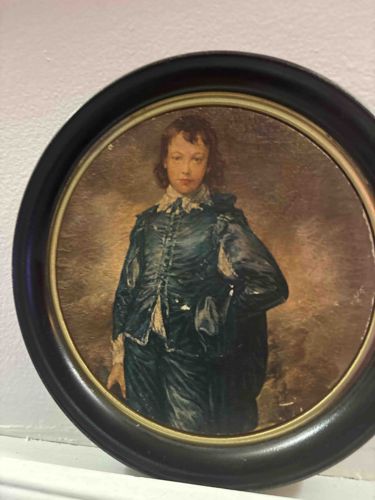
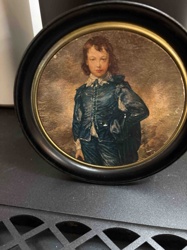
After Thomas Gainsborough, 'The Blue Boy' Tondo Portrait

Fine Art / Decorative Reproductions

AI Estimated Value

·Not an official valuation·Verify before acting

$45-75

As of May 27, 2026

AI Item Analysis

·AI can make mistakes·Verify before acting
This item is a circular (tondo) miniature or small-scale reproduction of the famous 1770 oil painting 'The Blue Boy' by Thomas Gainsborough. The piece depicts Jonathan Buttall in an 18th-century rendition of 17th-century apparel, specifically a blue satin tunic and breeches with a lace collar. The artwork appears to be a transfer print or a highly skillful hand-painted copy on a circular substrate, likely wood, metal, or paperboard. It is housed in a contemporary, dark-finished circular frame with a slim gold-toned fillet or inner border. The overall palette is dominated by deep indigo blues, creamy whites in the lace, and a warm, brownish-sepia background that mimics the aged varnish of an original Old Master work. In terms of condition, there is visible surface wear, including small white speckling or loss of pigment around the figure's midsection and near the upper left edge of the image area. The frame shows some minor scuffing. No visible maker's marks or signatures are present on the front, suggesting this is a 19th or 20th-century decorative accessory rather than an original period miniature. The craftsmanship of the reproduction captures the essence of the Gainsborough original, although the textures appear flatter than a true oil painting.

AI Appraisal Report

·AI can make mistakes·Verify before acting
I have examined the provided image of the tondo-format reproduction of Thomas Gainsborough's 'The Blue Boy.' Based on visual analysis, this is a 20th-century decorative accessory, likely produced as a souvenir or high-end mass-market home decor item. The flatness of the surface and specific patterns of wear suggest a transfer print on a rigid substrate rather than an original hand-painted miniature on ivory or vellum. Significant pigment loss and white speckling are visible in the central blue tunic area, which detracts from the aesthetic appeal and market value. The framing is contemporary and of modest quality. Market demand for 20th-century reproductions of 'The Blue Boy' is stable but high in supply, as this is one of the most reproduced images in art history. Comparable items frequently sell at estate auctions and secondary shops for nominal decorative prices. This valuation reflects its status as a non-original, unsigned work with notable condition issues. Please note that this appraisal is based strictly on photographic evidence. A formal authentication would require an in-person physical examination to determine the exact medium—specifically to rule out an overpainted lithograph or determine if the substrate is metal or synthetic. Scientific testing, such as microscopic inspection of the dot matrix or UV fluorescence to check for older pigment layers, would be necessary to establish a more precise date of manufacture, though the visual cues strongly indicate a mid-to-late 20th-century origin.

Get your items appraised

Instant estimates of your treasures with AI-powered appraisals

Browse More Appraisals