These notes were written by the person who submitted this item. Appraiser.AI has not verified them, and the AI's identification and estimate may rely on them.
AI Estimated Value
Not an official valuation
$40 - $60
AI estimate as of November 5, 2025 · verify with a professional before acting
AI-Generated · Verify before acting
Everything on this page is generated by AI for informational purposes only. AI can make mistakes — the AI may misidentify items or misattribute them (artist, maker, brand, designer, origin, era). This is not an official valuation and should not be used for insurance, sale, tax, estate, legal, or lending purposes — or any decision requiring a certified appraisal. It is not an authoritative claim about any person, brand, or rights holder — do not share or rely on it as a factual statement about a third party. Always consult qualified professionals before making financial decisions.
This analysis also relies on unverified notes provided by the user, which may be incomplete or inaccurate and could affect the result.
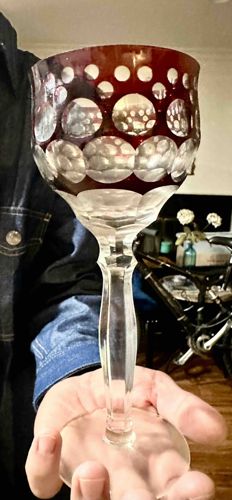
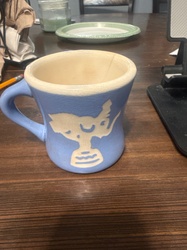
This is a vintage cut-to-clear wine hock glass, also commonly referred to as a Roemer glass, featuring a vibrant ruby red bowl. The glass is crafted from high-quality clear crystal or glass base, which has been overlaid with a layer of ruby red glass. The 'cut-to-clear' technique is evident in the repeated circular motifs that have been meticulously cut through the red layer, exposing the clear glass beneath. There are two distinct rows of these circular cuts around the bowl: a lower row with larger, more prominent circular facets, and an upper row with slightly smaller, less regularly spaced circular cuts, some of which appear as divots or depressions rather than full circles. The overall design suggests a bohemian or possibly German origin, common for this style of hock glass. The stem is faceted, likely hexagonal or octagonal in cross-section, lending an elegant taper from the bowl down to the circular foot. The foot itself appears plain and proportionate to the rest of the glass, providing stability. The craftsmanship is indicative of hand-cutting, as suggested by the slight variations in the circular patterns and their arrangement. No specific maker's marks or signatures are visible in the provided images. The condition appears good for a vintage item, with no immediately discernible chips, cracks, or significant wear. The clarity of both the red and clear glass components is excellent, suggesting well-maintained material quality. The style points to a mid-20th-century aesthetic, likely from the 1950s to 1970s, a period when cut-to-clear glassware was highly popular.
AI Appraisal Report
Upon visual examination of the provided image, this Vintage Ruby Red Cut-to-Clear Wine Hock Glass (Roemer) presents as an authentic example of mid-20th-century glassware. The cut-to-clear technique, particularly the two distinct rows of circular motifs, aligns well with documented styles from that era, often originating from Bohemian or German regions. The clarity of both the ruby red overlay and the clear crystal base is excellent, suggesting good preservation and quality materials. The faceted stem and proportionate foot contribute to its elegant form. As for condition, from the image alone, I discern no immediate chips, cracks, or significant wear, which is positive for a vintage piece. The slight variations in hand-cut patterns are expected and lend credibility to its handcrafted origin.
Market conditions for vintage cut-to-clear hock glasses are generally stable but not exceptionally strong, unless attributed to a renowned maker. Comparable items, often found on online marketplaces or antique stores, typically range from $25 to $75 per glass, depending on condition, rarity, pattern intricacies, and maker. While this piece is attractive, it lacks distinctive features or maker's marks that would elevate its value beyond this common range. Demand is moderate, primarily from collectors of vintage barware or specific glassware enthusiasts. Its rarity is low to moderate; while individual patterns vary, the general form and technique are common. Factors positively impacting its value are the good apparent condition and classic ruby red color, which is popular. The absence of a visible maker’s mark limits its top-tier value.
Limitations in authenticity verification from images alone are significant. While the style appears period-appropriate, a full authentication would require in-person examination to assess the glass quality, the precision of the cuts, weight, and detect any subtle repairs or hidden damage. Spectrographic analysis could confirm the composition of the glass, and blacklight testing could reveal repairs. Provenance documentation, such as original sales receipts or family history, would also strengthen its authenticity and potential value.