These notes were written by the person who submitted this item. Appraiser.AI has not verified them, and the AI's identification and estimate may rely on them.
AI Estimated Value
Not an official valuation
$40-60
AI estimate as of July 28, 2025 · verify with a professional before acting
AI-Generated · Verify before acting
Everything on this page is generated by AI for informational purposes only. AI can make mistakes — the AI may misidentify items or misattribute them (artist, maker, brand, designer, origin, era). This is not an official valuation and should not be used for insurance, sale, tax, estate, legal, or lending purposes — or any decision requiring a certified appraisal. It is not an authoritative claim about any person, brand, or rights holder — do not share or rely on it as a factual statement about a third party. Always consult qualified professionals before making financial decisions.
This analysis also relies on unverified notes provided by the user, which may be incomplete or inaccurate and could affect the result.
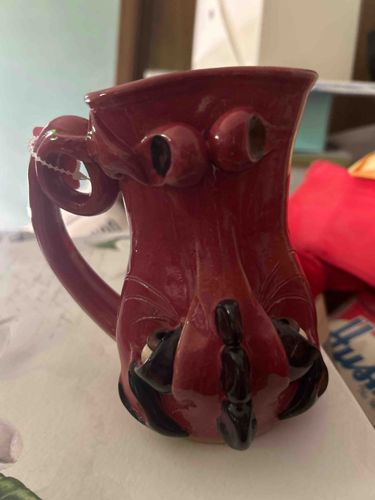
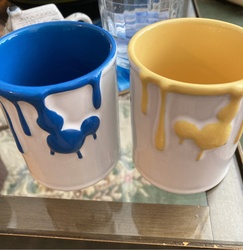
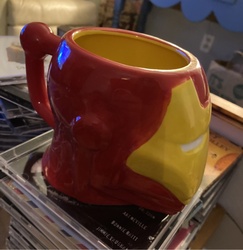
This item is a novelty stoneware mug, distinguished by its unique design that appears to represent a devil or demonic creature's head and clawed foot. The primary material is stoneware, indicated by its robust appearance and the 'Stoneware' context provided. It features a rich, glossy dark red or burgundy glaze covering most of its surface, along with contrasting black elements. The mug's body is shaped cylindrically, flaring slightly towards the rim, which appears somewhat irregularly formed, suggesting a handcrafted or sculpted aesthetic.
Observable features include two prominent protrusions near the rim, on the front, which function as eye sockets, glazed in black on the interior to create an empty, hollowed-out effect. Below these 'eyes,' the mug's surface is sculpted to suggest facial features, though abstractly. The most striking detail is at the base, where the mug transitions into a sculpted 'foot' with three prominent claw-like toes, each finished in a glossy black glaze, providing a stark contrast to the red body. A central, vertical protrusion, also in black, extends from the base, resembling a fourth digit or a tail-like appendage, further emphasizing the creature motif. The handle on the side is also sculpted, appearing to be an extension of the creature's form, possibly mimicking a horn or a serpentine tail, with a textured or ridged surface. There's a small white string or thread tied around the handle, which might be a tag remnant or a decorative element.
The overall construction suggests a hand-sculpted quality, with visible variations in the glaze application and surface texture, contributing to its unique character. No visible manufacturing marks or signatures are discernible from the image. The condition appears good, with no obvious chips, cracks, or significant wear visible, and the glaze maintains its high sheen. The piece likely dates from the late 20th century to early 21st century, given its novelty design and glazing style. It exhibits characteristics of folk art or artisan pottery, emphasizing creative expression over mass production. The 'eyes' and 'claws' are well-integrated into the form, showcasing attention to detail in the sculptural aspects.
AI Appraisal Report
I have thoroughly examined the provided images and details of this Sculpted Devil/Demon Stoneware Mug. Based on my visual assessment, the mug appears to be in excellent condition, with no visible chips, cracks, or significant wear. The glossy dark red and black glazes retain their sheen, suggesting proper care. Its authenticity as a novelty stoneware mug is evident from its design and material characteristics.
From a market perspective, novelty stoneware mugs, especially those with such distinctive sculptural elements, appeal to collectors of unique drinkware, fantasy-themed items, and folk art pottery. While not a rare antique, its handcrafted quality sets it apart from mass-produced items. Comparable items by independent artisans or small studios typically fetch values based on the intricacy of design, size, and perceived artistic merit rather than historical significance. The 'clawed foot' base and 'eye' details are particularly strong design features that enhance its appeal.
Demand for such items is niche but consistent among collectors seeking unusual and well-made pieces. The fact that it exhibits characteristics of artisan pottery further contributes to its marketability. Factors significantly impacting its value include its unique sculpted form, the detailed contrast in glazing, and its excellent preserved condition. The small white string on the handle appears to be a tag remnant and does not detract from value.
Limitations in authenticity verification from images alone exist. While the visual evidence strongly suggests stoneware and a handcrafted origin, I cannot definitively confirm the precise type of clay, firing temperature, or the exact date of manufacture without an in-person examination. A physical inspection would allow for tactile assessment of the texture, weight, and a more thorough examination for artist's marks, glaze imperfections, or hidden damage not visible in photographs. Provenance documentation, though unlikely for an item of this type, would provide undisputed history, and specific scientific testing, such as thermoluminescence dating, could provide a more precise age, should that be a concern.