AI identification & appraisal estimate

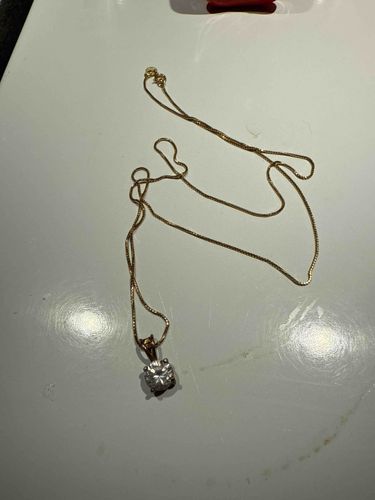
Solitaire Pendant Necklace

Submitted photo of Solitaire Pendant Necklace
Photo submitted by the user — not generated by AI

AI Estimated Value

Not an official valuation

$350-750

AI estimate as of November 7, 2025 · verify with a professional before acting

AI-Generated · Verify before acting

Everything on this page is generated by AI for informational purposes only. AI can make mistakes — the AI may misidentify items or misattribute them (artist, maker, brand, designer, origin, era). This is not an official valuation and should not be used for insurance, sale, tax, estate, legal, or lending purposes — or any decision requiring a certified appraisal. It is not an authoritative claim about any person, brand, or rights holder — do not share or rely on it as a factual statement about a third party. Always consult qualified professionals before making financial decisions.

Read the full disclaimer

AI Item Analysis

This is a classic solitaire pendant necklace featuring a single, round faceted gemstone (likely a diamond or a diamond simulant like cubic zirconia) set in a four-prong basket setting. The setting appears to be made of a white metal, possibly white gold or platinum, providing a strong contrast to the warm golden hue of the chain. The gemstone itself is substantial in size, exhibiting brilliance and sparkle, indicative of good cutting and clarity. It is securely held by four visible prongs that extend from the basket up and over the girdle of the stone. The pendant is suspended from a delicate gold-toned chain, which appears to be a box chain (also known as a Venetian chain) due to its square, box-like links that interlock smoothly. The chain has a consistent, lustrous finish. At one end of the chain, a small, round clasp mechanism, likely a spring ring clasp, is visible, designed for securing the necklace around the neck. The overall condition appears good with no obvious signs of significant wear or damage to the chain or the pendant setting. The simplicity of the design suggests a timeless appeal, making it suitable for various occasions. The craftsmanship appears to be standard for fine jewelry, with neatly finished prongs and chain links. The estimated age is likely contemporary, given the classic design which has remained popular for decades.
AI Appraisal Report

I have examined the provided image of this solitaire pendant necklace. The item presents as a classic design featuring a large, round faceted gemstone, securely set in a four-prong white metal basket setting, suspended from a delicate gold-toned box chain. Visually, the gemstone exhibits good brilliance and sparkle, suggesting a well-cut stone. The overall condition appears good, with no obvious signs of significant wear or damage to the chain or the pendant setting. The craftsmanship seems standard for contemporary fine jewelry. Authenticity of the gemstone (diamond vs. simulant) and metal purity cannot be definitively determined from an image alone. The brilliance observed could be from a well-cut cubic zirconia or a lower-grade diamond. Without closer inspection, including magnification and spectroscopic analysis, an exact identification is impossible. Similarly, the metal of the setting and chain could be white gold/platinum and yellow gold respectively, or gold-plated base metals. Market conditions for classic solitaire necklaces are generally stable, driven by consistent demand for timeless designs. Comparables can range significantly based on the true material composition. If the stone is a diamond, value would be considerably higher, depending on the 4 C's. If it is a high-quality diamond simulant with gold or gold-filled components, it would still hold value due to craftsmanship and aesthetic appeal. Given the classic design, demand is consistently moderate. Rarity is low as similar items are widely available. Factors significantly impacting value are the true identity of the central gemstone (diamond, moissanite, cubic zirconia), the karat and type of metal used for both the setting and the chain, and the overall weight of these precious metals. For full authentication and a precise valuation, an in-person examination by a certified gemologist is essential to identify the gemstone, test metal purity, and assess any microscopic inclusions or treatments. Provenance documentation could also provide insight into the stone's origin and potential treatments.

Keep exploring

More jewelry appraisals

Get your items appraised

Instant AI-powered appraisal estimates from a photo

Browse More Appraisals