AI estimate as of August 21, 2025 · verify with a professional before acting
AI-Generated · Verify before acting
Everything on this page is generated by AI for informational purposes only. AI can make mistakes — the AI may misidentify items or misattribute them (artist, maker, brand, designer, origin, era). This is not an official valuation and should not be used for insurance, sale, tax, estate, legal, or lending purposes — or any decision requiring a certified appraisal. It is not an authoritative claim about any person, brand, or rights holder — do not share or rely on it as a factual statement about a third party. Always consult qualified professionals before making financial decisions.
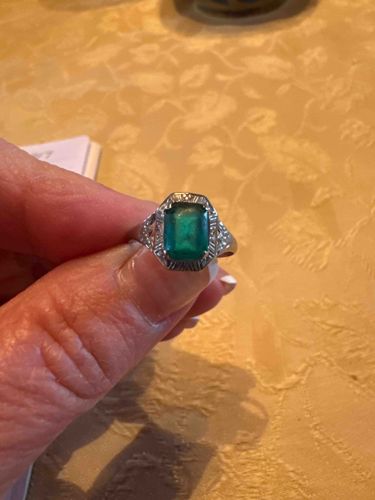
This item is an antique or vintage ring featuring a prominent rectangular, possibly emerald-cut, green gemstone, likely an emerald, set in a metallic band that appears to be silver or white gold. The central stone exhibits a deep, vivid green hue with visible internal inclusions or natural characteristics, consistent with an emerald. The bezel setting surrounding the emerald has a distinct milgrain edge, indicating fine craftsmanship. Flanking the central stone are two shield-shaped, stepped, or stylized geometric settings, each adorned with multiple smaller, clear gemstones, likely diamonds or diamond simulants. These side stones appear to be set in a pave or bead setting, and their arrangement contributes to an Art Deco or Art Nouveau aesthetic. The metalwork displays intricate detailing, possibly filigree or openwork patterns on the shoulders, adding to its vintage appeal. The ring shows some signs of wear commensurate with its age, such as possible light scratches on the metal or minor abrasions on the gemstone surface, which contribute to its patina rather than significant damage. The craftsmanship suggests a high level of skill, typical of fine jewelry from the early to mid-20th century. No specific maker's marks or signatures are visible in the provided image. The overall design is elegant and classic, indicative of a piece intended for special occasions or daily wear by someone fond of antique jewelry.
AI Appraisal Report
Based on my visual examination of the provided image, I appraise this Emerald and Diamond Cluster Ring. The central green gemstone exhibits characteristics consistent with a natural emerald, showing good color saturation and visible inclusions, which is typical for emeralds. The milgrain bezel setting surrounding the emerald, along with the intricate metalwork and the shield-shaped diamond accents, strongly suggests an Art Deco or early 20th-century vintage origin. The smaller clear gemstones flanking the emerald appear to be diamonds or high-quality simulants, set in a style indicative of the era. The overall condition appears to be very good for a piece of this age, with signs of wear commensurate with its vintage, contributing to its patina rather than detracting significantly from its appeal.
In terms of market conditions, vintage jewelry, especially pieces with genuine emeralds and diamonds from the Art Deco period, consistently fetches strong demand. Comparables in the market show similar Art Deco emerald and diamond rings ranging significantly depending on stone quality, metal purity, and craftsmanship. This piece's elegant design and apparent craftsmanship contribute to its desirability. The rarity is moderate; while Art Deco pieces are sought after, this specific design is not uniquely singular but is a classic example of the period.
Factors impacting value include the likelihood of the central stone being a natural emerald, the quality and authenticity of the diamonds, and the precious metal content (likely white gold or platinum, given the era and design). The intricate detailing and overall aesthetic appeal enhance its value.
It is crucial to state that my authentication is based solely on visual cues from the image. For full authentication, an in-person examination is essential to verify gemstone identity (natural vs. synthetic, type of treatment), diamond authenticity (natural vs. simulant), metal purity, and to search for any maker's marks or hallmarks. Scientific testing (e.g., specific gravity, refractive index for the emerald; diamond testing for the side stones) would be necessary for definitive authentication. Provenance documentation, if available, would also add to its verifiable history and value.