AI estimate as of November 13, 2025 · verify with a professional before acting
AI-Generated · Verify before acting
Everything on this page is generated by AI for informational purposes only. AI can make mistakes — the AI may misidentify items or misattribute them (artist, maker, brand, designer, origin, era). This is not an official valuation and should not be used for insurance, sale, tax, estate, legal, or lending purposes — or any decision requiring a certified appraisal. It is not an authoritative claim about any person, brand, or rights holder — do not share or rely on it as a factual statement about a third party. Always consult qualified professionals before making financial decisions.
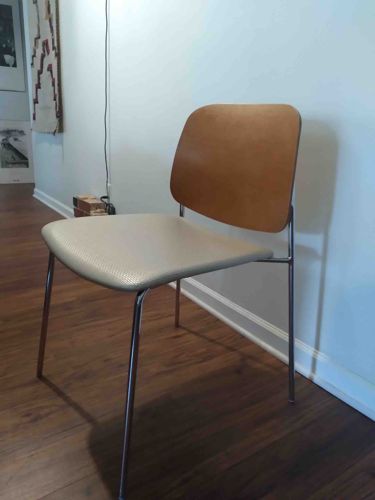
This is a contemporary-style stackable chair, likely from the mid-20th century, characterized by its minimalist design and combination of natural wood and metal. The backrest is constructed from a single piece of light-toned, possibly bent plywood or laminated wood, exhibiting a gentle curve for ergonomic support. The coloration of the wood appears to be a natural blonde or light maple finish, showcasing subtle grain patterns. The seat is upholstered in a light beige or off-white material, possibly vinyl or a durable synthetic fabric, with a fine, textured pattern that could be a very small perforation or woven effect, adding a slight visual interest without detracting from the sleek design. The upholstery is well-fitted with no visible rips, tears, or significant staining, suggesting good overall condition. The frame consists of slender, polished metal tubing, most likely chrome-plated steel, which forms the four legs and supports the seat and backrest. The legs appear to be straight and slightly splayed for stability, tapering subtly towards the floor. There are no visible feet or glides on the bottom of the legs in the provided image. The chair exhibits clean lines and a functional aesthetic, characteristic of Danish modern or similar mid-century design movements focused on utility and simplicity. There are no discernible maker's marks, signatures, or specific manufacturing details visible in the image. The overall condition appears to be very good, with no obvious signs of significant wear, corrosion on the metal, or damage to the wood or upholstery. The design emphasizes lightness and practicality, making it suitable for dining, office, or general seating.
AI Appraisal Report
This Mid-Century Modern stackable chair presents as a well-preserved example of minimalist design, likely from the 1950s or 1960s. Visually, the condition appears very good; the bent plywood backrest retains its natural blonde finish without obvious damage, and the light beige upholstered seat shows no significant stains, rips, or tears. The chrome-plated steel frame maintains its polish, with no visible corrosion or structural issues from the image. Its clean lines and combination of natural wood with metal are characteristic of Danish modern aesthetics, prioritizing functionality and simplicity.
Authenticity, based solely on this image, is limited. While it strongly aligns with the mid-century modern style, the absence of maker's marks or specific manufacturing details prevents definitive identification of a designer or manufacturer. This significantly impacts its potential value. If this were a piece by a renowned designer like Arne Jacobsen or Fritz Hansen, even without explicit marks, the form and construction details would allow for a more precise attribution, driving up the value significantly. However, without such verification, it is appraised as a high-quality, un-attributed piece in the style of.
Market conditions for un-attributed mid-century modern furniture are stable, with demand for good condition examples. Comparables for similar un-attributed chairs in very good condition typically range from $200-$450. The stackable feature adds a practical appeal. Rarity is low for this general style, as many manufacturers produced similar designs. Factors that would boost value significantly include clear provenance, a confirmed designer attribution, or discovery of a rare manufacturing mark.
For full authenticity verification, an in-person examination is crucial to assess construction methods, material quality (e.g., specific wood species, upholstery composition), and to search for hidden marks. Documentation proving its origin would also be highly beneficial. Scientific testing could confirm materials but is generally not cost-effective for pieces in this price range without prior strong attribution evidence.