These notes were written by the person who submitted this item. Appraiser.AI has not verified them, and the AI's identification and estimate may rely on them.
AI Estimated Value
Not an official valuation
$15 - $25
AI estimate as of October 11, 2025 · verify with a professional before acting
AI-Generated · Verify before acting
Everything on this page is generated by AI for informational purposes only. AI can make mistakes — the AI may misidentify items or misattribute them (artist, maker, brand, designer, origin, era). This is not an official valuation and should not be used for insurance, sale, tax, estate, legal, or lending purposes — or any decision requiring a certified appraisal. It is not an authoritative claim about any person, brand, or rights holder — do not share or rely on it as a factual statement about a third party. Always consult qualified professionals before making financial decisions.
This analysis also relies on unverified notes provided by the user, which may be incomplete or inaccurate and could affect the result.
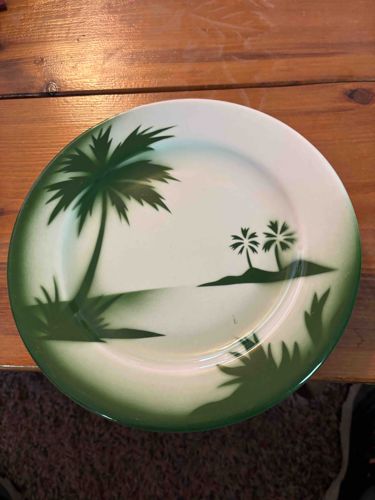
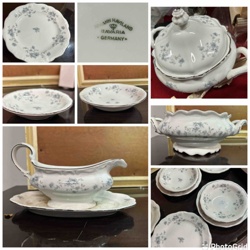
This is a ceramic dinner plate featuring a tropical motif. The plate is predominantly off-white or cream-colored, with a wide rim that transitions into a darker green hue, creating a gradient effect. The central design depicts a stylized tropical landscape in a darker shade of green, applied using a stenciled or airbrushed technique. On the left side, a large palm tree silhouette dominates the foreground, with its fronds extending towards the center of the plate. To the right, two smaller palm trees are depicted on a raised landform, suggesting an island or distant shore. Additional foliage silhouettes frame the bottom right and left edges of the plate, enhancing the tropical theme. The craftsmanship appears to be industrial, likely mass-produced, indicated by the consistent application of the design. The plate's surface has a subtle sheen, suggesting a glazed finish. The overall condition appears to be excellent, with no visible chips, cracks, or significant wear. The colors are vibrant and well-preserved. Based on the provided context, the bottom of the plate is marked 'Jackson Falls Creek, PA', which indicates the manufacturer and origin. This marking is crucial for pinpointing the plate's manufacturing details and estimated age, likely mid-20th century, consistent with similar decorative dinnerware of that era. The design aesthetic suggests a vintage style, possibly from the 1950s or 1960s, reflecting a popular desire for exotic and vacation-inspired themes in home decor.
AI Appraisal Report
I have examined the provided image of the Jackson Falls Creek, PA Tropical Palm Tree Dinner Plate, along with the owner's description. The plate presents in excellent condition, showing no visible chips, cracks, or significant wear. The vibrant colors and glazed finish appear well-preserved, suggesting careful handling throughout its history. The "Jackson Falls Creek, PA" marking on the bottom is crucial for authentication and dating, placing this piece likely in the mid-20th century (1950s-1960s), a period when tropical motifs were popular in home decor. The design, while charming and reflective of its era, appears to be industrially produced, indicating mass manufacturing rather than artisanal craftsmanship.
Market conditions for vintage mass-produced dinnerware with a tropical theme are generally stable but not highly lucrative. Comparables in the secondary market, encompassing similar vintage decorative plates from regional American manufacturers, typically fall into a modest price range. Demand for such items is primarily from collectors of vintage dinnerware or those furnishing period-specific interiors. While the condition is excellent, and the design is appealing, the item's mass-produced nature limits its rarity. There isn't significant historical or artistic prominence associated with this particular manufacturer or pattern that would drive a higher valuation.
Factors significantly impacting its value include its excellent condition and the clear backstamp, which assures its identity and origin. However, its mass-produced status and the absence of any unique design elements prevent it from reaching higher values reserved for more limited production or artist-signed pieces. My assessment of authenticity is based on the visual congruence with known production methods and typical marks of the era. However, an in-person examination would be needed to definitively rule out reproductions or fakes, particularly to assess the tactile quality of the glaze, the precise nature of the decal/stencil application, and to verify the authenticity of the backstamp under magnification. Provenance documentation, such as original sales receipts or family history, would also strengthen authentication.