AI Appraisal Estimate

AI-generated estimates · not official valuations

From the user

What was submitted

Photo and notes provided by the user — not generated by AI

Submitted item photo
Submitted photo · May 30, 2026

User's notes

No additional notes provided.

AI analysis below

AI appraisal

AI analysis & estimate

AI-Generated · Verify before acting

Everything below is generated by AI for informational purposes only. AI can make mistakes — the AI may misidentify items or misattribute them (artist, maker, brand, designer, origin, era). This is not an official valuation and should not be used for insurance, sale, tax, estate, legal, or lending purposes — or any decision requiring a certified appraisal. It is not an authoritative claim about any person, brand, or rights holder — do not share or rely on it as a factual statement about a third party. Always consult qualified professionals before making financial decisions.

Read the full disclaimer

AI Identification

·Not independently authenticated·Verify before acting

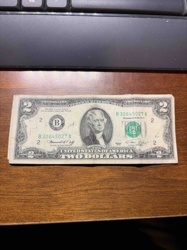
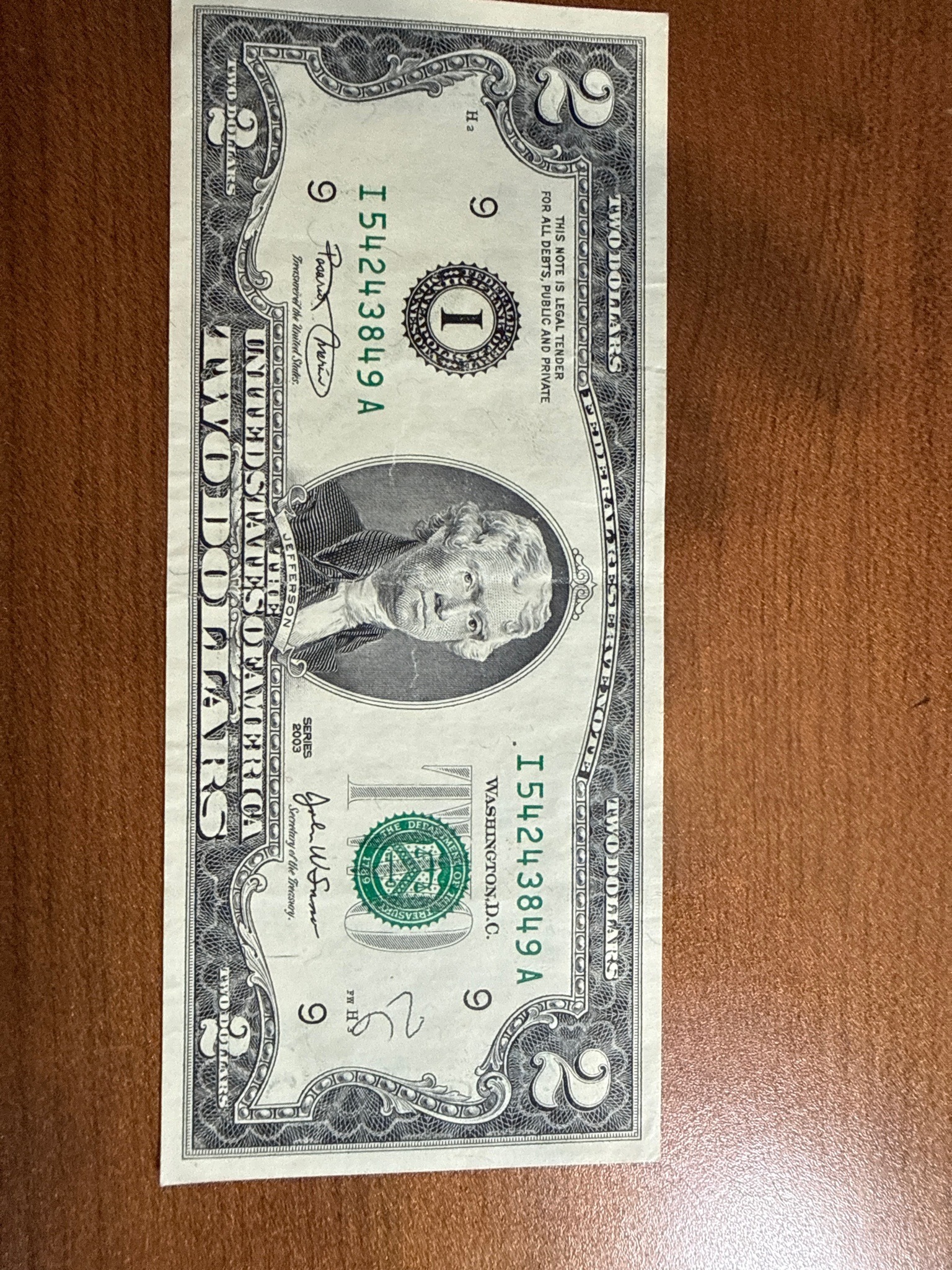
Series 2003 $2 Federal Reserve Note

Numismatics / US Paper Currency

AI Estimated Value

·Not an official valuation·Verify before acting

$2.00

As of May 30, 2026

AI Item Analysis

·AI can make mistakes·Verify before acting
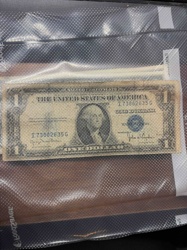
This is a United States two-dollar bill, specifically a Federal Reserve Note from the Series 2003 production run. The obverse features a centered portrait of Thomas Jefferson, the third President of the United States, based on a painting by Gilbert Stuart. The note is printed on standard cotton-linen currency paper, displaying the characteristic green and black intaglio ink. Notable markings include the green Treasury Seal on the right and the black Federal Reserve District Seal for Minneapolis (indicated by the letter 'I' and the number '9') on the left. The serial number 'I 54243849 A' is printed twice in green ink. Signatures of Rosario Marin (Treasurer of the United States) and John W. Snow (Secretary of the Treasury) are present. Regarding condition, the bill shows signs of circulation including several vertical folds and one prominent horizontal crease, suggesting it was once folded into quarters. There is a handwritten ink mark '26' or '2.6' near the bottom right signature, which acts as a 'teller mark' or graffiti, detracting from the pristine numismatic value. The edges show slight softening and a minor corner tick at the top left, but no significant tearing or heavy staining is visible. The printing remains sharp with good contrast, and the paper retains a relatively clean, off-white appearance despite the mechanical wear from handling.
AI Appraisal Report

·AI can make mistakes·Verify before acting
Upon visual examination of this Series 2003 $2 Federal Reserve Note (Minneapolis district), I find the note to be in 'Circulated' condition, likely grading at a Very Fine (VF) to Extra Fine (EF) level if not for the specific defects observed. The note displays multiple vertical folds and a heavy horizontal crease, indicating it was handled in general commerce. Most significantly, the presence of a handwritten ink 'teller mark' on the obverse drastically reduces its numismatic appeal. From a market perspective, Series 2003 $2 bills were printed in massive quantities (over 121 million for the 'I' district alone). Because these notes are not old enough to be rare and this specific serial number (I54243849A) does not qualify as a 'fancy serial' (such as a radar, repeater, or low number), it carries no premium over its face value. Collectors typically seek these notes in 'Choice Uncirculated' condition (Grade 63+) or with printing errors to justify a price above $2. While the intaglio printing and security features suggest authenticity, a definitive verification cannot be made via digital image alone. A physical inspection would be required to verify the 'feel' of the cotton-linen paper, the raised texture of the ink, and the presence of red and blue security fibers. No scientific testing like UV light exposure or infrared scanning is warranted here, as the cost of such authentication would far exceed the market value of the note. In its current state, the item is considered 'spending money' rather than a numismatic investment.

Get your items appraised

Instant estimates of your treasures with AI-powered appraisals

Browse More Appraisals