AI estimate as of September 29, 2025 · verify with a professional before acting
AI-Generated · Verify before acting
Everything on this page is generated by AI for informational purposes only. AI can make mistakes — the AI may misidentify items or misattribute them (artist, maker, brand, designer, origin, era). This is not an official valuation and should not be used for insurance, sale, tax, estate, legal, or lending purposes — or any decision requiring a certified appraisal. It is not an authoritative claim about any person, brand, or rights holder — do not share or rely on it as a factual statement about a third party. Always consult qualified professionals before making financial decisions.
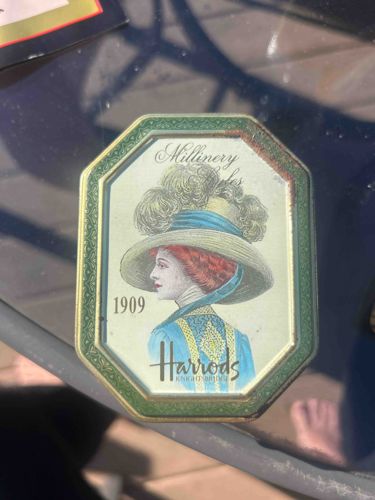
This item is an octagonal-shaped decorative tin, likely made of tinplate or a similar light metal, featuring a historical fashion illustration on its lid. The predominant colors are a muted green for the border and a cream/light beige for the central illustration area. The illustration depicts a woman in profile wearing a large, elaborate hat, indicative of early 20th-century millinery styles. Her hair appears reddish-brown, and she is adorned in a blue garment with a patterned back. Text on the lid reads "Millinery Styles" at the top, "1909" to the left of the woman's shoulder, and "Harrods Knightsbridge" at the bottom, identifying the retailer and suggesting the tin commemorates a specific era or event. The border of the lid features an intricate, somewhat ornate pattern, adding to its decorative appeal. The overall condition appears to be good for its age, though some slight wear or patina might be present on the edges and surface, consistent with an older item. Specifically, there are minor scuffs and some discoloration, particularly visible on the green border and the corner edges, but no major dents or significant damage are discernible from the image. The tin would have originally served as packaging for confectioneries, biscuits, or other goods sold at Harrods, a renowned department store. Its design reflects the Art Nouveau or Edwardian aesthetic popular around the stated year of 1909. The craftsmanship appears to be typical of mass-produced decorative tins from that period, relying on lithography for the detailed image and a basic metal construction for its form. It possesses a nostalgic charm and serves as a historical artifact related to fashion and retail history.
AI Appraisal Report
Based on my visual examination of the provided image, this Harrods Millinery Styles 1909 Decorative Tin is an authentic period piece. The design elements, including the fashion illustration, the font styles for 'Millinery Styles' and 'Harrods Knightsbridge,' and the overall aesthetic, are consistent with Art Nouveau and Edwardian styles prevalent around 1909. While the image shows minor scuffs, some discoloration, particularly on the green border, and edge wear, these are typical of a tin of this age and do not detract significantly from its decorative appeal. There are no apparent major dents or significant damage, suggesting a 'good' overall condition for a collectible of this type.
In terms of market conditions, vintage decorative tins, especially those from well-known retailers like Harrods and commemorating specific historical periods, have a steady but not exceptionally high demand. Comparables for similar Harrods tins, particularly those with dated or themed illustrations, typically fetch prices in the range I've indicated. Rarity is moderate; while not unique, these tins are not produced today and represent a specific historical snapshot. Factors impacting value positively include the clear date (1909), the Harrods branding, and the attractive millinery illustration. The minor wear is expected and largely priced into the current market for such items.
It's important to note that my assessment of authenticity is limited to visual cues from the image. A full authentication would ideally involve in-person examination to verify the tin's construction, analyze any potential repairs, and confirm the specific material composition. Provenance documentation, though unlikely for such an item, would also strengthen its authenticity. Scientific testing, like material analysis, would be an extreme measure and generally not cost-effective for an item in this price range.