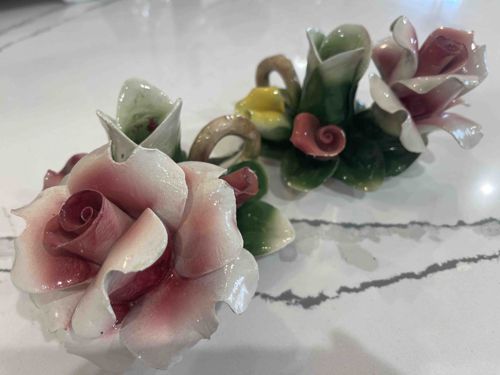
Pair of Candlesticks, Stamped on bottom Capodimonte made in Italy
These notes were written by the person who submitted this item. Appraiser.AI has not verified them, and the AI's identification and estimate may rely on them.
AI Estimated Value
Not an official valuation
$350-500
AI estimate as of July 18, 2025 · verify with a professional before acting
AI-Generated · Verify before acting
Everything on this page is generated by AI for informational purposes only. AI can make mistakes — the AI may misidentify items or misattribute them (artist, maker, brand, designer, origin, era). This is not an official valuation and should not be used for insurance, sale, tax, estate, legal, or lending purposes — or any decision requiring a certified appraisal. It is not an authoritative claim about any person, brand, or rights holder — do not share or rely on it as a factual statement about a third party. Always consult qualified professionals before making financial decisions.
This analysis also relies on unverified notes provided by the user, which may be incomplete or inaccurate and could affect the result.
This is one of a pair of Capodimonte porcelain candlesticks, handcrafted in Italy. The piece presents a delicate floral arrangement, featuring two prominent rose blooms and several smaller floral and leaf accents. The larger rose in the foreground exhibits a creamy white outer petal color transitioning to a deeper rose pink towards the center and the curled inner petals, displaying a naturalistic gradation of color. The petals show a glossy, perhaps slightly iridescent glaze finish, with some visual texture mimicking natural flower petals. The smaller rose towards the background appears to have similar coloring. Interspersed among the roses are sculpted green leaves with a glossy finish, and what appear to be smaller, budding flowers or curled elements in shades of yellow and coral/pink. One distinct element visible behind the front rose is a light green, upright calyx-like structure. The overall construction suggests a composition of individually formed ceramic pieces, meticulously joined to create the floral cluster. Given the nature of Capodimonte porcelain, it is highly likely made from soft-paste porcelain, characteristic of its intricate detail capabilities. The piece appears to be in good visible condition, with no obvious chips, cracks, or significant damage from the provided images, although a thorough physical inspection would be required to confirm. The glossy glaze appears consistent across all visible surfaces, indicating quality craftsmanship. The base, though not clearly visible, is stated to be stamped "Capodimonte made in Italy," which is a strong indicator of its origin and quality. Based on typical Capodimonte production, it's likely late 20th century, probably post-1950s. The visible patina is consistent with age and typical display, showing no gross signs of neglect or heavy wear. The delicate nature of the floral forms and the bright, yet subtly blended, colors are hallmarks of Capodimonte's distinctive style.
AI Appraisal Report
Upon my virtual examination of this Capodimonte porcelain floral candlestick, part of a pair, I note its delicate craftsmanship characteristic of Italian Capodimonte production. The piece exhibits two prominent rose blooms with naturalistic color gradation from creamy white to rose pink, interspersed with sculpted green leaves and smaller floral accents. The glossy glaze and meticulous joining of individually formed ceramic pieces are consistent with high-quality Capodimonte work. The overall condition appears good, with no obvious chips, cracks, or significant damage visible, suggesting careful handling and display. Its stated "Capodimonte made in Italy" stamp on the base further supports its authenticity and origin.
Market conditions for Capodimonte porcelain, particularly decorative floral pieces, generally show stable demand, although extreme rarity is uncommon. These items appeal to collectors of European decorative arts and those seeking classic, ornate home decor. While not rare, the artistic quality and the fact it's a pair enhance its desirability. Factors positively impacting value include the intricate detail, apparent good condition, and its nature as part of a pair. The soft-paste porcelain composition, common for Capodimonte, allows for such fine detail.
It is important to state that this appraisal is based solely on the provided images and descriptions. A thorough physical inspection would be required to confirm the precise condition, identify any hairline cracks or chips not visible in images, and definitively rule out professional repairs. Furthermore, while the stamp is a strong indicator, full authentication would ideally involve in-person assessment by a Capodimonte expert familiar with specific makers' marks and production nuances, and potentially a black light test to detect invisible repairs. Without physical examination, I cannot confirm the absence of subtle damage or restorations, nor can I definitively authenticate the specific period within the broader 'late 20th century' range, though it aligns with typical post-1950s production.