AI estimate as of September 26, 2025 · verify with a professional before acting
AI-Generated · Verify before acting
Everything on this page is generated by AI for informational purposes only. AI can make mistakes — the AI may misidentify items or misattribute them (artist, maker, brand, designer, origin, era). This is not an official valuation and should not be used for insurance, sale, tax, estate, legal, or lending purposes — or any decision requiring a certified appraisal. It is not an authoritative claim about any person, brand, or rights holder — do not share or rely on it as a factual statement about a third party. Always consult qualified professionals before making financial decisions.
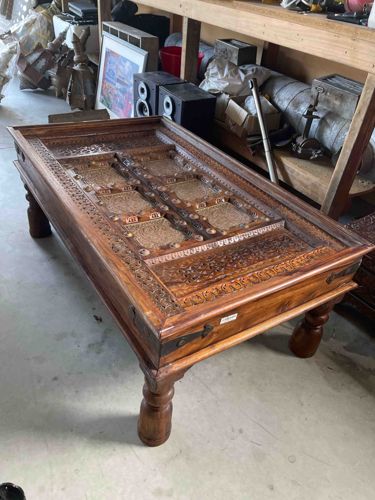
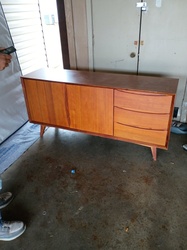
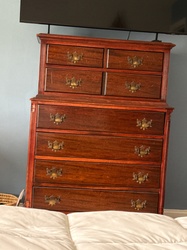
This is a rectangular coffee table crafted from dark-stained wood, likely teak or a similar hardwood, showcasing a substantial and rustic aesthetic. Its most defining feature is the intricately carved top, which appears to be fashioned from an antique door or a panel designed to emulate one. The tabletop is divided into several rectangular sections, each featuring detailed geometric and floral carvings, particularly evident around the perimeter and within the central panels. These panels are further embellished with metal inlay, possibly brass or copper, which adds a striking contrast to the dark wood and enhances the ornate design. The metal elements within the panels appear to be embossed or hammered, creating a textured surface. The edges of the table are also adorned with continuous carved patterns. The table rests on four robust, turned wooden legs, providing sturdy support and contributing to its traditional or exotic appeal. Visible hardware includes decorative metal plates or brackets, possibly for structural reinforcement or simply for aesthetic embellishment, seen at the corners where the side panels meet. The overall condition appears good, with a well-maintained finish, though potential minor wear consistent with use and age would be expected, such as small scratches or indentations on the surface, which are not clearly visible in the provided image. The rich, deep brown color of the wood suggests a desirable patina has developed. The craftsmanship indicates a handmade item, possibly from a South Asian or Mediterranean region, reflecting traditional carving techniques and materials. The table exhibits quality construction and intricate artisanal work, making it a unique furniture piece.
AI Appraisal Report
Upon examining the image of this Carved Wooden Coffee Table with Metal Inlay, I assess its condition to be good. The dark-stained wood, likely a hardwood such as teak, exhibits a rich, deep brown color consistent with a well-maintained finish and a desirable patina. The intricate carvings, especially the geometric and floral motifs on the tabletop and edges, show excellent detail. The metal inlay, possibly brass or copper, provides a striking contrast and appears intact, suggesting careful handling. While not clearly visible in the image, I anticipate minor wear such as small scratches or indentations typical for a used and aged piece.
Authenticity, based solely on visual inspection, points strongly to a handmade object, possibly originating from a South Asian or Mediterranean region due to the traditional carving techniques and a design that evokes repurposing an antique door or panel. This artisan craftsmanship is a key value driver. The robust turned legs and decorative metal plates suggest quality construction.
In terms of market conditions, items with a bespoke, handcrafted, and exotic aesthetic currently enjoy a solid demand. Comparables for such uniquely carved and inlaid coffee tables, especially those with a perceived age and craftsmanship, typically fall into the mid-to-high hundreds. The rarity factor comes from its unique design rather than being part of a mass-produced line. Factors significantly impacting value include the quality of the carving, the material of the metal inlay, and its overall structural integrity.
It is important to note the limitations of an appraisal based purely on imagery. To definitively authenticate the wood species, confirm the metal composition, and accurately assess the age and origin, an in-person examination would be crucial. A tactile inspection would allow for the detection of repairs, proper assessment of structural stability, and detailed evaluation of the finish and any minor damage. Provenance documentation, such as purchase receipts or historical information, would significantly enhance the authentication process and could potentially elevate the value.