These notes were written by the person who submitted this item. Appraiser.AI has not verified them, and the AI's identification and estimate may rely on them.
AI Estimated Value
Not an official valuation
$10 - $25
AI estimate as of July 17, 2025 · verify with a professional before acting
AI-Generated · Verify before acting
Everything on this page is generated by AI for informational purposes only. AI can make mistakes — the AI may misidentify items or misattribute them (artist, maker, brand, designer, origin, era). This is not an official valuation and should not be used for insurance, sale, tax, estate, legal, or lending purposes — or any decision requiring a certified appraisal. It is not an authoritative claim about any person, brand, or rights holder — do not share or rely on it as a factual statement about a third party. Always consult qualified professionals before making financial decisions.
This analysis also relies on unverified notes provided by the user, which may be incomplete or inaccurate and could affect the result.
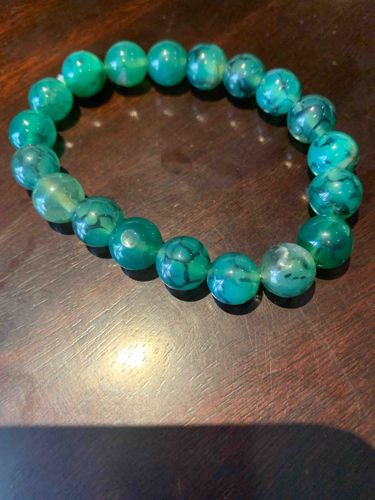
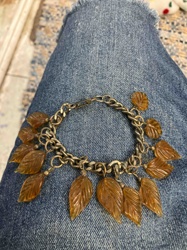
This item is a beaded stretch bracelet comprising approximately 17-18 spherical beads. Each bead appears to be crafted from a translucent to semi-translucent stone, exhibiting a vibrant spectrum of green hues, ranging from a pale, almost mossy green to a deep, rich teal or emerald. A distinctive feature of many of the beads is a natural crackle or web-like pattern, possibly enhanced through a 'dragon vein' treatment, where the stone is heated and then rapidly cooled to create internal fractures, which are then often dyed to highlight the cracks. Some beads display a more uniform, milky green transparency with fewer internal patterns, suggesting slight variations in the stone or treatment. The beads are polished to a high sheen, reflecting light, and appear to be smooth to the touch, indicating good quality finishing. The size of the beads seems consistent, likely ranging from 8mm to 12mm in diameter, making them suitable for a wrist accessory. The bracelet is constructed on an elastic cord, allowing it to stretch and fit various wrist sizes, which is a common and practical design for this type of casual jewelry. There are no visible clasps, suggesting it is a continuous loop. There are no obvious signs of significant wear, chips, or damage visible in the provided image; the beads consistently maintain their round shape and polished surface, indicating good preservation. No manufacturer's marks, signatures, or specific age indicators are discernible from the image, but this style of beaded bracelet is popular in contemporary and fashion jewelry, likely dating from the late 20th century to the present day. The overall craftsmanship appears standard for mass-produced or artisan-made stone bead jewelry.
AI Appraisal Report
Upon examining the images provided, I have assessed this beaded stretch bracelet, identified as being made from Green Dragon Vein Agate. The bracelet consists of approximately 17-18 spherical beads, each showcasing vibrant green hues and a distinct 'crackle' or web-like pattern. This pattern is characteristic of a treatment process where the stone, likely agate, is heated and rapidly cooled to create internal fractures, which are then often filled with dye to enhance the effect. The beads appear uniformly sized (estimated 8-12mm), well-polished, and in excellent condition with no visible chips or significant wear.
The market for this type of fashion jewelry is largely driven by aesthetics rather than intrinsic material value. Agate is a common and affordable semi-precious gemstone. The 'dragon vein' treatment, while visually appealing, is a common enhancement and does not add significant value. Comparable new bracelets of this style are widely available online and in retail stores, typically priced in the lower-end fashion jewelry segment. The demand is steady but not exceptional, as the market is saturated with similar items.
Critically, this appraisal is based solely on visual inspection of images. Without physical examination, I cannot definitively confirm the material as natural agate versus a synthetic or glass imitation. Gemological testing would be required to verify the stone's identity and determine the nature of the treatment (e.g., dyeing). The presumed modern origin and mass-production characteristics limit its value primarily to that of an attractive, wearable accessory.