AI estimate as of August 19, 2025 · verify with a professional before acting
AI-Generated · Verify before acting
Everything on this page is generated by AI for informational purposes only. AI can make mistakes — the AI may misidentify items or misattribute them (artist, maker, brand, designer, origin, era). This is not an official valuation and should not be used for insurance, sale, tax, estate, legal, or lending purposes — or any decision requiring a certified appraisal. It is not an authoritative claim about any person, brand, or rights holder — do not share or rely on it as a factual statement about a third party. Always consult qualified professionals before making financial decisions.
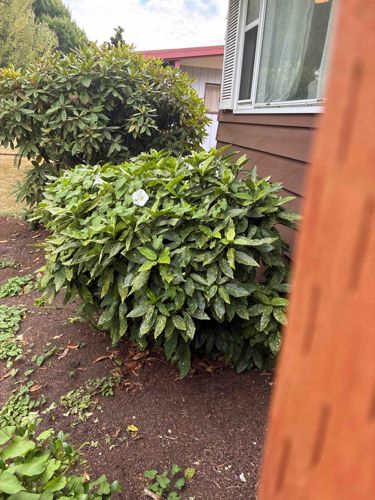
The primary item identified is a mature evergreen shrub, likely a variety of Prunus laurocerasus (Cherry Laurel) or similar broadleaf evergreen, characterized by its dense growth habit and glossy, dark green leaves. The leaves generally appear ovate to oblong with fine serrations along the edges, although specific leaf venation or texture is not clearly discernible from this distance. Many leaves exhibit a speckled or mottled appearance, which could indicate a natural variegation, a fungal issue such as powdery mildew, or the presence of some type of residue like hard water stains or dust. The shrub is approximately 3 to 4 feet in height and 5 to 6 feet in width, showing signs of regular pruning to maintain its rounded, bushy form. Nestled within the foliage, particularly near the top-center, there is a single, prominent white flower, suggestive of a large-petaled variety, possibly a Magnolia or a large-flowered Camellia, that appears to have fallen onto the bush, as it doesn't seem to be growing from it. The shrub is planted in a mulched bed of dark brown earth, which is relatively free of weeds directly beneath the bush, though some groundcover and smaller weeds are visible further to the left in the wider shot. The overall condition of the shrub appears healthy in terms of vigor, with abundant foliage, although the speckled leaves might indicate areas needing attention. There are no discernible manufacturer's marks or specific age indicators, but its size suggests a planted age of at least several years, potentially 5-10 years or more, depending on growth rate.
AI Appraisal Report
I have examined the provided image of what appears to be a mature evergreen shrub, most likely Prunus laurocerasus. The shrub exhibits a dense, well-established form with abundant foliage, indicative of good vigor. Its size, approximately 3-4 feet high and 5-6 feet wide, suggests a maturity of 5-10 years. The overall condition appears healthy, with regular pruning evident to maintain its rounded shape. However, I note a speckled or mottled appearance on many leaves. While this could be variegation, it might also indicate a fungal issue like powdery mildew, nutrient deficiency, or residue. A direct physical examination would be necessary to ascertain the exact cause and severity.
Authenticity as a "Prunus laurocerasus" is based on visual characteristics consistent with the species; however, definitive identification would require closer inspection of leaf morphology, bark, and bud structure. The prominent white flower, clearly not originating from the shrub, appears to be a fallen bloom, possibly from a Magnolia or large-flowered Camellia. This is a temporary aesthetic element and does not impact the shrub's inherent value.
In terms of market conditions, mature, well-established evergreen shrubs of this size and species are commonly available in nurseries and garden centers. While generally not considered rare, their value is in their immediate landscape impact. Demand is consistent for instant landscaping solutions. Comparables would include similar broadleaf evergreens, valued based on size, health, and species. Factors impacting value positively are its apparent health and established size, offering immediate visual appeal. The negative factor is the leaf speckling; if it's a disease, remediation costs would reduce its net value. Without direct inspection, I cannot confirm the specific Prunus laurocerasus cultivar or rule out underlying health issues. Provenance documentation regarding its specific age, planting conditions, and original source would also enhance certainty.
For full authentication of species and assessment of overall health, an in-person examination, including tactile assessment of leaves, inspection for pests/diseases, and potentially soil testing, would be essential. Without this, my assessment of its long-term viability and exact identification remains limited to visual inference.