AI estimate as of August 4, 2025 · verify with a professional before acting
AI-Generated · Verify before acting
Everything on this page is generated by AI for informational purposes only. AI can make mistakes — the AI may misidentify items or misattribute them (artist, maker, brand, designer, origin, era). This is not an official valuation and should not be used for insurance, sale, tax, estate, legal, or lending purposes — or any decision requiring a certified appraisal. It is not an authoritative claim about any person, brand, or rights holder — do not share or rely on it as a factual statement about a third party. Always consult qualified professionals before making financial decisions.
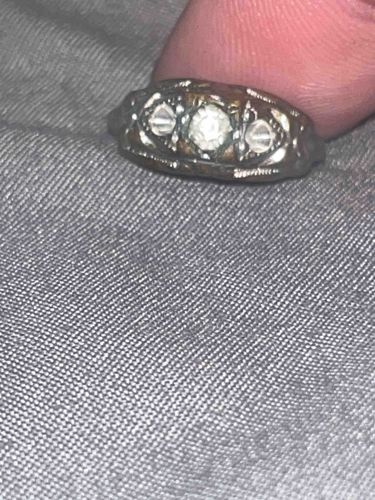
The item is a vintage-style ring, likely made of a base metal such as sterling silver or a white gold alloy, given its tarnished appearance with a dull, greyish sheen and hints of a warmer, possibly brassy or oxidized undertone in recesses. The ring features an elongated oval or navette-shaped head, typical of Art Deco or Edwardian designs, approximately 15-20mm in length. The setting is adorned with three prominently displayed, round, colorless stones, with the central stone appearing slightly larger than the two flanking ones. These stones are cut in a brilliant or rose-cut style, characterized by numerous facets that catch the light, though their exact nature (diamond, cubic zirconia, or paste/glass) cannot be definitively determined from the image. The metalwork around the stones is intricately detailed, featuring open filigree or pierced designs that give the ring a delicate, airy feel. The filigree includes scrolling motifs and potentially small beadwork (milgrain) along the edges of the settings or the band itself. The band appears to be a consistent width, or possibly tapering slightly towards the back, and shows signs of wear consistent with age, including surface scratches and a noticeable patina or oxidation in the recessed areas of the filigree, which enhances the contrast of the design. No clear maker's marks or hallmarks are visible in the provided image. The overall impression is one of an older, possibly antique or vintage piece, reflecting the craftsmanship of the early to mid-20th century. The quality of the setting appears to be good, with stones securely held, and the intricate design points to a piece with careful attention to detail in its manufacture.
AI Appraisal Report
Upon my virtual examination of this Vintage/Antique Filigree Ring with Three Stones, I observe a charming piece, highly indicative of Art Deco or Edwardian aesthetics, likely dating from the early to mid-20th century. The intricate filigree and milgrain detailing showcase craftsmanship typical of the era, suggesting quality in its manufacture. The elongated head and three-stone design are classic. The dull, grayish sheen and significant tarnish indicate a base metal, possibly sterling silver or a low-karat white gold alloy, explaining the 'warmer, possibly brassy' undertones in recesses due to oxidation. The stones' identity is crucial; without physical inspection or testing, I cannot definitively determine if they are diamonds, white sapphires, paste, or cubic zirconia. This significantly impacts value.
Market conditions for vintage filigree rings depend heavily on the metal and stone composition. If the stones are genuine diamonds and the metal is gold, the value would be substantially higher. However, given the visual cues, I suspect the stones are likely paste or early simulants, common in such decorative filigree pieces from this period, made for broader affordability. Demand exists for vintage-style jewelry, particularly delicate designs like this. Its rarity is moderate; while filigree rings are not uncommon, a piece with this particular shape and stone arrangement in good, albeit tarnished, condition appeals to collectors of period jewelry.
Limitations are significant: I cannot verify authenticity of materials (metal purity, stone type) or assess specific condition issues like stone security or band integrity from photos alone. For full authentication and accurate valuation, a physical examination would be imperative to test the metal (acid or XRF), identify the stones (refractometer, microscopy), and thoroughly assess the wear and any repairs. Without these steps, the valuation remains an estimate based on visual style and probable materials.
Considering the likelihood of it being sterling silver with paste or early simulant stones, in "good" antique condition with noticeable patina, I've arrived at my appraisal value. Should the stones prove to be genuine diamonds or high-quality white sapphires, or the metal be platinum, the value would increase dramatically.