AI estimate as of July 4, 2025 · verify with a professional before acting
AI-Generated · Verify before acting
Everything on this page is generated by AI for informational purposes only. AI can make mistakes — the AI may misidentify items or misattribute them (artist, maker, brand, designer, origin, era). This is not an official valuation and should not be used for insurance, sale, tax, estate, legal, or lending purposes — or any decision requiring a certified appraisal. It is not an authoritative claim about any person, brand, or rights holder — do not share or rely on it as a factual statement about a third party. Always consult qualified professionals before making financial decisions.
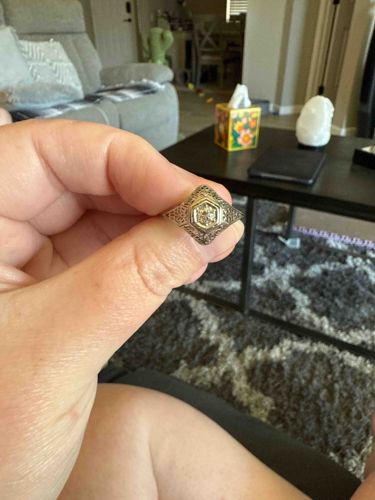
This is an antique or vintage filigree ring, likely crafted from white gold or platinum, given its silvery-white luster and intricate openwork design. The ring features a distinct hexagonal head, characteristic of the Art Deco or Edwardian period, often associated with the early 20th century (circa 1900-1930s). The central setting holds a single, faceted gemstone, most likely a diamond, which appears to be cushion-cut or old mine cut due to its visible facets and potential depth. The stone is surrounded by a milgrain-edged bezel or illusion setting, giving the impression of a larger stone. The filigree work on the shoulders and gallery of the setting is exceptionally fine, showcasing delicate scrollwork and geometric patterns typical of the period, indicating a high level of craftsmanship. The openwork design contributes to its light and airy aesthetic. Due to its age, there might be slight wear consistent with regular use, such as minor scratches on the metal or very slight abrasion on the facets of the stone, but no significant damage or repairs are immediately apparent from the image. The metal shows a subtle patina, common with older pieces, which can enhance its antique appeal. The overall construction appears sturdy for its intricate nature. The specific size of the ring is difficult to ascertain without a reference, but it appears to be a medium-sized statement piece rather than a delicate band.
AI Appraisal Report
Upon visual examination of the provided image, I assess this antique/vintage filigree ring to be in very good condition for its presumed age. The intricate filigree work, characteristic of the Art Deco or Edwardian period (circa 1900-1930s), appears largely intact with no obvious breaks or significant deformation. The subtle patina on the metal, likely white gold or platinum, is consistent with age and indicates authenticity rather than a modern reproduction. The central stone, most probably an old mine cut or cushion-cut diamond, shows good clarity and brilliance from the image, and the milgrain-edged setting is well-preserved.
Market conditions for antique jewelry, particularly pieces with fine filigree and genuine diamonds from these periods, remain strong among collectors and enthusiasts. Comparables would include similar era rings with central diamonds (typically 0.25-0.50 ct equivalent) and detailed craftsmanship. Demand for well-preserved examples is consistent due to their unique aesthetic and historical significance. Rarity is moderate; while many such rings were produced, finding one in this condition with quality filigree and a decent central stone is becoming less common.
Factors significantly impacting value include the quality of the central diamond (carat, cut, color, clarity), the specific metal (platinum would command a higher value than white gold), and the fineness of the filigree work. The hexagonal head is a desirable design element.
It is crucial to note that this appraisal is based solely on visual assessment of an image. Full authentication of the metal type (e.g., platinum vs. white gold), the precise characteristics and authenticity of the central stone (e.g., natural diamond vs. simulant, exact carat weight, color, clarity grades), and the presence of any hidden repairs or damage would require an in-person examination by a certified gemologist. This would involve specific gravity tests, magnification under a jeweler’s loupe, and potentially spectrographic analysis. Provenance documentation, if available, would also add to the verifiable authenticity and value.