AI estimate as of December 4, 2025 · verify with a professional before acting
AI-Generated · Verify before acting
Everything on this page is generated by AI for informational purposes only. AI can make mistakes — the AI may misidentify items or misattribute them (artist, maker, brand, designer, origin, era). This is not an official valuation and should not be used for insurance, sale, tax, estate, legal, or lending purposes — or any decision requiring a certified appraisal. It is not an authoritative claim about any person, brand, or rights holder — do not share or rely on it as a factual statement about a third party. Always consult qualified professionals before making financial decisions.
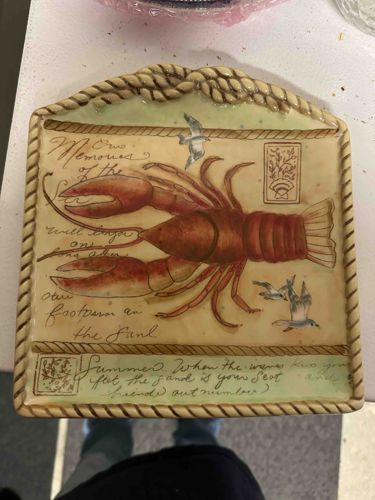
This appears to be a decorative ceramic or porcelain plate, presented in a rectangular shape with rounded corners at the top, giving it a somewhat shield-like or plaque-like appearance. The primary material seems to be glazed ceramic, indicated by its glossy finish and the way light reflects off its surface, particularly on the rope-like border. The color palette is predominantly muted, featuring a cream-colored background for the main scene, bordered by a light sage green band at the top and bottom. A heavily textured, three-dimensional rope-like motif forms the outer edge of the plate, rendered in a light brown or beige color, suggesting a nautical theme. The central illustration depicts a large, vibrant red lobster, typical of a cooked American lobster, positioned horizontally across the plate. Artistic script text is integrated into the design, with phrases like 'Memories of the Sea' and legible portions of a poem 'When there were two you and I, footprints on the sand'. Two seagulls are flying in the background, one near the top left and another pair near the bottom right. There are also small, framed graphical elements, one at the top right featuring what looks like a stylized plant and shell, and another at the bottom left with a similar, less distinguishable pattern. The craftsmanship suggests a commercially produced decorative item, possibly from the late 20th or early 21st century, designed for home decor rather than functional use as a dinner plate. The condition appears good, with no immediately visible chips, cracks, or significant wear to the glaze based on the provided image.
AI Appraisal Report
I have virtually examined this Nautical Lobster Themed Decorative Plate based on the provided image. My assessment of its condition, based solely on visual inspection, is good; I observe no apparent chips, cracks, or significant wear to the glaze. Authenticity, in terms of being a commercially produced decorative item, appears clear. Its rectangular shape with rounded corners, a three-dimensional rope border, and a vibrant lobster illustration with integrated text ('Memories of the Sea' and poetic excerpts) strongly suggest a mass-produced item designed for home decor. The ceramic or porcelain material and glazed finish are consistent with such items.
Market conditions for decorative plates of this nature are generally soft. Similar mass-produced, contemporary decorative items with nautical or themed motifs often retail new for modest prices. In the secondary market, demand is typically low unless the item is part of a collectible series, has significant age, or is from a renowned manufacturer, none of which appear to be the case here. Rarity is not a factor; items like this were likely produced in large quantities. Factors significantly impacting value include its decorative rather than functional nature, lack of discernible artist attribution or manufacturer marks (from the image), and its relatively recent production aesthetic (likely late 20th to early 21st century).
My valuation is based on its appeal as a decorative accent piece. Limitations in authenticity verification from images alone are significant. I cannot confirm the material (ceramic vs. porcelain) or identify any manufacturer's marks, which would typically be on the reverse side. An in-person examination would be needed to inspect the reverse for maker's marks, assess the true tactile quality of the piece, and confirm the absence of any subtle damage not visible in the photograph. Provenance documentation or scientific testing are generally not relevant for items of this type and value.