AI estimate as of August 28, 2025 · verify with a professional before acting
AI-Generated · Verify before acting
Everything on this page is generated by AI for informational purposes only. AI can make mistakes — the AI may misidentify items or misattribute them (artist, maker, brand, designer, origin, era). This is not an official valuation and should not be used for insurance, sale, tax, estate, legal, or lending purposes — or any decision requiring a certified appraisal. It is not an authoritative claim about any person, brand, or rights holder — do not share or rely on it as a factual statement about a third party. Always consult qualified professionals before making financial decisions.
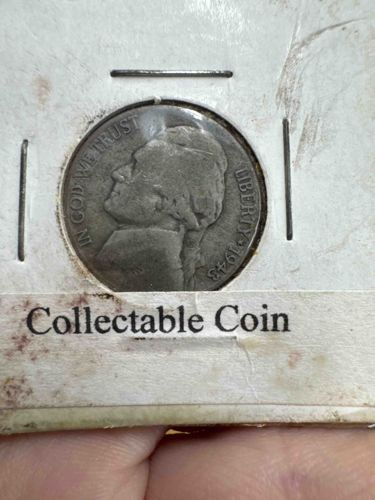
The item is a 1943 Jefferson Nickel, presented in a standard cardboard coin holder with a Mylar or plastic window, labeled "Collectable Coin." The coin is silver-colored, but its metallic composition during 1943 was a war-time alloy of 35% silver, 56% copper, and 9% manganese, designed to conserve nickel for the war effort. The obverse prominently features a left-facing profile of Thomas Jefferson, designed by Felix Schlag. Markings visible include "IN GOD WE TRUST" along the left rim and "LIBERTY" with the date "1943" along the right rim. The coin exhibits significant wear, particularly on Jefferson's portrait where details like his hair and facial features are smoothed out. There is a general dullness and possibly some minor surface scratches or environmental residue, indicated by the darker, mottled appearance of the metal. No specific mint mark is clearly discernible from the visible portion, which would typically be above Monticello on the reverse for this particular year or to the right of Monticello in later years; however, the 'P' mint mark for Philadelphia was introduced on the reverse above Monticello in 1942, and 'S' for San Francisco and 'D' for Denver could also be present on wartime issues. The overall condition suggests it was in circulation for a considerable period before being housed. The edges of the coin holder appear aged, with some discoloration and minor wear, and dark spots that could be residue or mild mold.
AI Appraisal Report
I have examined the provided image of the 1943 Jefferson Nickel. Based on the visual evidence, the coin is authentic, consistent with a wartime silver alloy nickel due to its duller, mottled appearance, which is typical for this composition after significant circulation. "IN GOD WE TRUST," "LIBERTY," and the "1943" date are clearly discernible. The coin exhibits significant wear, particularly on Jefferson's portrait, where details are largely effaced. This level of wear places its condition at AG-G (About Good to Good) on the Sheldon scale. The coin holder shows age, but does not significantly impact the coin's value.
From a market perspective, 1943 'P', 'S', and 'D' Jefferson Nickels, particularly in circulated condition, are common and readily available. Their value is primarily driven by their silver content and novelty as 'war nickels,' rather than numismatic rarity. Even uncirculated examples are not scarce. The lack of a visible mint mark is typical for heavily circulated coins, and doesn't negatively impact the value, as all mints produced large quantities.
Factors significantly impacting value are the high degree of wear and the general prevalence of this issue. There is consistent demand for war nickels due to their silver content and historical significance, but this is a low-value collector segment. Comparables in similar circulated condition typically trade for minimal premiums above melt value.
Limitations: Authenticity is strongly supported by the image, but a definitive assessment of surface issues (e.g., environmental damage vs. specific scratches, possible cleaning) requires in-hand examination. Additionally, the exact mint mark, while not crucial for value at this condition level, could only be confirmed with a clear view of the reverse. For full authentication of higher-grade or rare varieties, provenance documentation and scientific testing (e.g., alloy analysis) would be necessary, though unnecessary for this common, circulated example.