AI estimate as of October 17, 2025 · verify with a professional before acting
AI-Generated · Verify before acting
Everything on this page is generated by AI for informational purposes only. AI can make mistakes — the AI may misidentify items or misattribute them (artist, maker, brand, designer, origin, era). This is not an official valuation and should not be used for insurance, sale, tax, estate, legal, or lending purposes — or any decision requiring a certified appraisal. It is not an authoritative claim about any person, brand, or rights holder — do not share or rely on it as a factual statement about a third party. Always consult qualified professionals before making financial decisions.
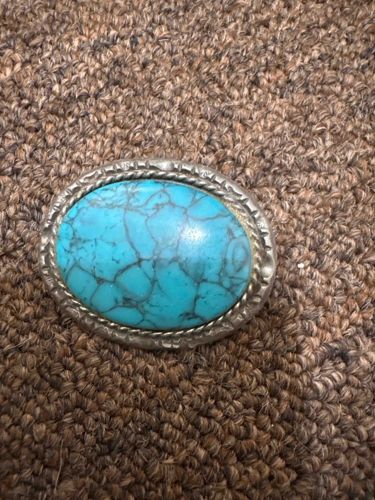
This item is an oval-shaped belt buckle featuring a large, prominent turquoise cabochon set within a metallic frame. The turquoise stone exhibits a vibrant sky-blue hue with distinctive dark brown or black matrix veining, characteristic of natural turquoise, possibly from mines known for spiderweb matrix patterns. The stone has a polished, domed surface, creating a smooth and inviting tactile quality. It appears to be an oval cabochon cut, securely set within a bezel. The metallic frame surrounding the turquoise is silver-toned, likely silver or a silver-plated alloy, and features a textured, possibly hammered or distressed, outer edge that gives it an aged or rustic appearance. Immediately bordering the turquoise cabochon is a twisted rope-like detail, a common decorative element in Southwestern or Native American-inspired jewelry and accessories, which adds a layer of visual interest and craftsmanship. The overall condition appears good, with a visible patina on the metal suggesting some age and use, but no overt signs of significant damage such as cracks in the stone or major dents in the metal. The craftsmanship indicates a handmade or artisan-crafted piece, emphasizing the natural beauty of the gemstone. Given its aesthetics, it likely belongs to a Western, Southwestern, or bohemian style period, with an estimated age ranging from mid-20th century to contemporary.
AI Appraisal Report
I have examined the image of this Turquoise Oval Cabochon Belt Buckle. Visually, the piece presents well; the turquoise cabochon is an attractive sky-blue with distinct spiderweb matrix, indicative of natural material and potentially desirable origins. The cabochon appears securely set within a bezel, and the polished surface is smooth. The metal frame, silver-toned, shows a textured finish and a twisted rope detail bordering the stone, suggesting a Southwestern or artisan-crafted aesthetic. The visible patina is consistent with age and use, not neglect, enhancing its rustic appeal. I detect no immediate signs of significant damage like cracks in the stone or major dents in the metal from the image provided, indicating good overall condition.
Authenticity of the turquoise as natural and origin of the metal (silver vs. plated) cannot be definitively confirmed without in-person examination. A precise determination of the turquoise type (e.g., Kingman, Sleeping Beauty) would require scientific testing or expert gemological assessment. Without hallmarks, the metal content remains speculative based on appearance alone.
Market conditions for Southwestern or artisan-style turquoise buckles are generally stable, driven by collectors and enthusiasts of Western wear. Comparables for unsigned, naturally attractive turquoise buckles of this size and style typically range. Demand is consistent but not extremely high, and while attractive, similar pieces are not exceptionally rare. Factors impacting value include the actual grade and origin of the turquoise, the metal purity (sterling silver would command a higher value than plated), and the presence of any artist's marks or tribal attribution, which is not apparent here.
Limitations: My assessment of authenticity and material specifics is based solely on visual cues from the image. For full verification, an in-person examination is critical to test the metal composition, assess the stone's properties (refractive index, specific gravity), and search for any hidden maker's marks or hallmarks. Provenance documentation would also be invaluable for establishing the piece's history and potential artist.