These notes were written by the person who submitted this item. Appraiser.AI has not verified them, and the AI's identification and estimate may rely on them.
AI Estimated Value
Not an official valuation
$20-40
AI estimate as of September 14, 2025 · verify with a professional before acting
AI-Generated · Verify before acting
Everything on this page is generated by AI for informational purposes only. AI can make mistakes — the AI may misidentify items or misattribute them (artist, maker, brand, designer, origin, era). This is not an official valuation and should not be used for insurance, sale, tax, estate, legal, or lending purposes — or any decision requiring a certified appraisal. It is not an authoritative claim about any person, brand, or rights holder — do not share or rely on it as a factual statement about a third party. Always consult qualified professionals before making financial decisions.
This analysis also relies on unverified notes provided by the user, which may be incomplete or inaccurate and could affect the result.
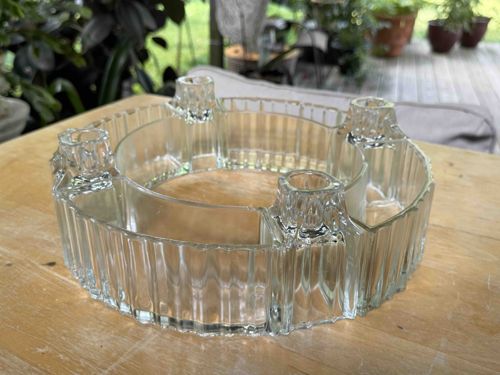
This item is a clear pressed glass centerpiece ring, designed for both candles and floral arrangements, often referred to as a flower frog or candle ring. It is constructed from transparent, colorless glass, allowing it to blend seamlessly with various decor styles. The overall shape is a circular or wreath-like form, featuring an inner perimeter that would typically hold water for flowers or greenery, and an outer perimeter with an undulating or scalloped edge. Integrated into the outer ring are four distinct, raised candle holders, evenly spaced around the circumference. These candle holders are fluted or ribbed on their exterior, creating a decorative visual texture and likely designed for standard taper candles. The main body of the ring, both the inner and outer walls, is characterized by prominent vertical ribbing or fluting, a common design element in pressed glass from the mid-20th century. The base appears flat, ensuring stability. There are no visible maker's marks or signatures in the provided image. The glass exhibits good clarity, suggesting it is well-preserved, though minor scuffs or dust may be present due to typical use or display, which would generally be considered light wear rather than damage. The craftsmanship points to mass production via pressing, common for utility and decorative glass items of its likely era. The design is classic and functional, indicating an estimated age from the mid-century to late 20th century.
AI Appraisal Report
Based on my visual examination of the provided image of this clear pressed glass centerpiece ring with taper candle holders, often referred to as a flower frog or candle ring, I assess its overall condition as good. The glass appears clear and transparent, with no immediately visible chips, cracks, or significant damage. Minor scuffs or dust, as noted, are consistent with typical use and would be considered light wear. The vertical ribbing and fluted candle holders are characteristic of pressed glass manufacturing from the mid-20th century to late 20th century, aligning with the design's classic and functional aesthetic.
This item, identified as an '8 piece candle and flower holder glass,' is a common type of vintage decorative glassware. Authenticity, based solely on an image, is limited; however, the design and manufacturing style are consistent with mass-produced pressed glass of the era. The lack of maker's marks is typical for many such utilitarian and decorative glass pieces from that period. Market conditions for these items are generally stable but not exceptionally strong. Comparable items are frequently found in antique malls, thrift stores, and online marketplaces, typically priced in the lower vintage decorative category.
Demand for such pressed glass centerpiece rings is moderate, driven primarily by collectors of vintage home decor or individuals seeking functional and aesthetically pleasing table centerpieces. Rarity is low; these items were produced in large quantities. Factors significantly impacting value include the excellent condition of the glass (absence of chips or cracks is key), the appealing design, and its functionality. Without a physical inspection, I cannot confirm the exact weight, feel, or true absence of subtle imperfections that might affect its value. Full authentication would ideally involve a hands-on examination to check for subtle manufacturing flaws, material quality, and any embedded marks not visible in the image. However, given the type of item, extensive provenance documentation or scientific testing is generally not pursued for pieces of this value. My appraisal reflects its current market standing as a nice, functional piece of vintage pressed glass.