AI estimate as of October 18, 2025 · verify with a professional before acting
AI-Generated · Verify before acting
Everything on this page is generated by AI for informational purposes only. AI can make mistakes — the AI may misidentify items or misattribute them (artist, maker, brand, designer, origin, era). This is not an official valuation and should not be used for insurance, sale, tax, estate, legal, or lending purposes — or any decision requiring a certified appraisal. It is not an authoritative claim about any person, brand, or rights holder — do not share or rely on it as a factual statement about a third party. Always consult qualified professionals before making financial decisions.
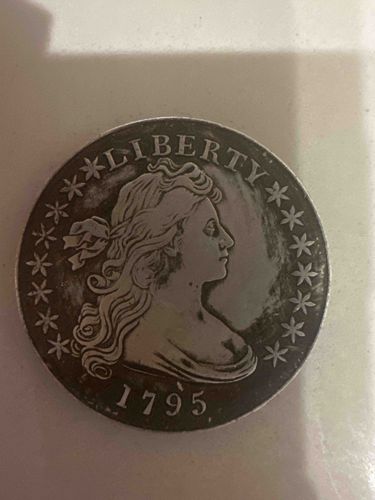
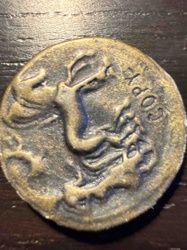
The item is a circular, metallic object, appearing to be a coin, specifically a replica or counterfeit of a 1795 Flowing Hair Dollar. The predominant color is a dark, toned silver-gray, with some lighter, shinier areas, particularly on the raised portions of the design, suggesting selective polishing or wear. The obverse depicts a right-facing bust of Lady Liberty with long, flowing hair, tied back with a ribbon. The facial features are somewhat indistinct, and the hair lacks the fine detail often seen on genuine early American coinage, appearing rather blocky in places. Above Liberty's head, the word "LIBERTY" is inscribed in a semi-circle. Flanking the bust are stars, with several visible on the left and a few on the right. Below the bust, the date "1795" is clearly legible. The overall relief of the design seems shallow, and certain elements, like the stars, lack crispness. There is significant dark toning or possibly artificial patination in the fields (the flat areas of the coin) which contrasts with the lighter highlights on the design elements. This uneven and somewhat aggressive toning, coupled with the soft details and somewhat crude appearance of the design elements, raises strong suspicions about its authenticity. The condition shows some surface irregularities and inconsistencies that are not typical of a genuine, well-preserved antique coin. The overall craftsmanship appears to be of lower quality than an authentic U.S. Mint issue from the period. Given these observations, it is highly likely a modern reproduction or counterfeit rather than a genuine 1795 Flowing Hair Dollar. Genuine Flowing Hair Dollars are exceedingly rare and valuable, and this piece does not exhibit the characteristics of an authentic example.
AI Appraisal Report
Based on my examination of the provided image, this item is unequivocally a replica or counterfeit of a 1795 Flowing Hair Dollar. The deep, uneven, and somewhat aggressive toning, especially in the fields, strongly suggests artificial patination. The most telling indicators are the shallow relief, lack of crisp detail in elements like Liberty's hair and the stars, and the overall soft appearance of the design, which is inconsistent with authentic U.S. Mint coinage of this period. Genuine Flowing Hair Dollars exhibit much finer detail and craftsmanship. The somewhat crude facial features and blocky hair further confirm its inauthenticity.
Market conditions for such replicas are extremely low. There is no numismatic demand for counterfeit items, and their value is limited to their material content or as a novelty item. Comparables would include other modern coin replicas, which typically sell for a few dollars. Rarity is not a factor here; while genuine 1795 Flowing Hair Dollars are rare, this piece holds no intrinsic numismatic rarity. The primary factor impacting its 'value' is its status as a non-authentic item.
Given that this is a replica/counterfeit, its value is purely as a decorative item or base metal. For a physical appraisal, I would conduct a weight and diameter check against known specifications for genuine pieces, assess edge characteristics, and potentially perform a specific gravity test or metal analysis to confirm composition. Authenticity cannot be definitively verified from images alone, but the visual cues here are overwhelming, making further physical authentication steps primarily for confirming it's not a higher-quality contemporary counterfeit, which is unlikely given the presented details.