These notes were written by the person who submitted this item. Appraiser.AI has not verified them, and the AI's identification and estimate may rely on them.
AI Estimated Value
Not an official valuation
$10-$20
AI estimate as of August 2, 2025 · verify with a professional before acting
AI-Generated · Verify before acting
Everything on this page is generated by AI for informational purposes only. AI can make mistakes — the AI may misidentify items or misattribute them (artist, maker, brand, designer, origin, era). This is not an official valuation and should not be used for insurance, sale, tax, estate, legal, or lending purposes — or any decision requiring a certified appraisal. It is not an authoritative claim about any person, brand, or rights holder — do not share or rely on it as a factual statement about a third party. Always consult qualified professionals before making financial decisions.
This analysis also relies on unverified notes provided by the user, which may be incomplete or inaccurate and could affect the result.
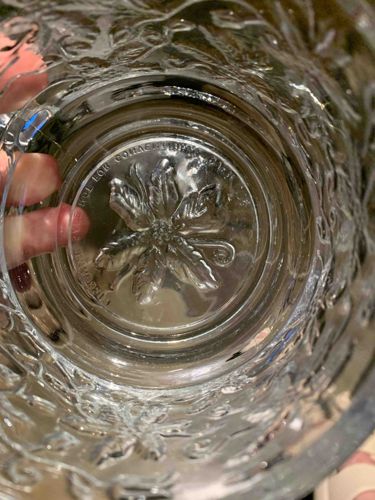
This item is a large, clear glass mug, likely designed for beverages such as beer or other large volume drinks. Its most distinctive feature is the heavily textured and embossed exterior, giving it a somewhat rustic or classic aesthetic. The primary decorative motif appears to be a repeating pattern of leaves and possibly some floral elements, such as poinsettias, consistent with the provided context. The interior of the mug is smooth, allowing for easy cleaning, while the impressive raised relief on the exterior provides a tactile surface for grip and visual appeal. The base of the mug is particularly notable, featuring a prominent, deeply molded floral design, which strongly resembles a poinsettia bloom. This central motif is surrounded by raised text in a circular pattern, with some legible words such as "COLLAGE" and "FROM" visible, suggesting a potential brand name, collection name, or perhaps a commemorative inscription. The glass appears to be thick and durable, indicative of a utilitarian design meant for regular use. There are no immediate visible signs of cracks or significant chips, suggesting good overall condition. The clarity of the glass is excellent, with no noticeable cloudiness or significant internal scratching that would detract from its appearance. The manufacturing technique is likely molded glass, given the intricate relief work. The style suggests a possible vintage or classic design, potentially from the mid-to-late 20th century, though without more specific manufacturer marks or a clearer view of the text, a precise age is difficult to pinpoint. The craftsmanship appears to be of good quality, with consistent molding and detail, enhancing its decorative and functional appeal. The large size implies it's suitable for a substantial serving, making it practical for parties or casual home use.
AI Appraisal Report
Upon examining the provided images and description of this Poinsettia large glass mug, I have assessed its characteristics and market position. The mug is a well-crafted piece of molded glass, likely from the mid-to-late 20th century. Its most notable features are the deep embossed poinsettia and leaf pattern on the exterior and the distinct floral motif on the base. The mug appears to be in excellent condition, with no visible chips, cracks, or significant clouding, which is a positive factor for its value. The visible text, including 'COLLAGE' and 'FROM', suggests it may be part of a larger collection or a commemorative item, but a clear identification of the manufacturer is not possible from the images alone.
Currently, the market for vintage glassware of this type is robust but highly dependent on brand recognition, rarity, and specific patterns. While the Poinsettia motif is popular, especially for holiday-themed items, similar unbranded or mass-produced decorative mugs are quite common. Comparable large, molded glass mugs from this era, without a high-demand maker's mark (such as Anchor Hocking or Libbey in specific, sought-after lines), typically sell for modest prices. The primary driver of value for this piece is its decorative appeal and condition rather than rarity or brand prestige. A physical, in-person examination would be required to identify any maker's marks, assess the glass quality more definitively, and confirm the absence of subtle damage. Without such confirmation, my assessment is based on the assumption that this is a quality but likely mass-produced decorative item.