AI estimate as of August 26, 2025 · verify with a professional before acting
AI-Generated · Verify before acting
Everything on this page is generated by AI for informational purposes only. AI can make mistakes — the AI may misidentify items or misattribute them (artist, maker, brand, designer, origin, era). This is not an official valuation and should not be used for insurance, sale, tax, estate, legal, or lending purposes — or any decision requiring a certified appraisal. It is not an authoritative claim about any person, brand, or rights holder — do not share or rely on it as a factual statement about a third party. Always consult qualified professionals before making financial decisions.
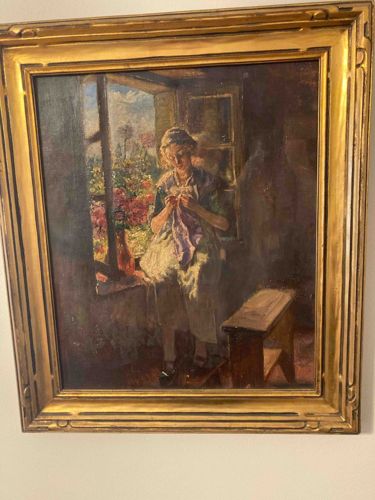
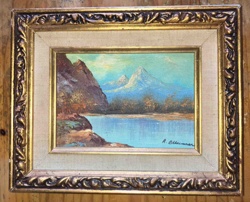
This item is an antique framed oil painting depicting a domestic scene. The painting features a woman, likely engaged in needlework or knitting, positioned by a sunlit window. Her attire appears to be simple, possibly a dress or apron, rendered in muted tones. The window, on the left side of the composition, opens to a vibrant outdoor scene with discernible flowers and greenery, suggesting a garden or natural landscape. The interior space around the woman is softly lit but generally darker, creating a contrast with the bright exterior. A wooden stool or small bench is visible on the right side of the painting, adding depth to the room. The brushwork appears to be loose and impressionistic, capturing light and atmosphere rather than minute detail, characteristic of early 20th-century or late 19th-century art. The painting is housed within a substantial, ornate gilded wooden frame with visible carved or molded decorative elements, exhibiting signs of age through its rich patina and minor wear along its edges and corners. There are no immediately obvious significant condition issues such as tears or major paint loss visible from this distance, though some age-related craquelure might be present upon closer inspection. The overall quality suggests a skilled hand, though without a visible signature or artist's mark, specific manufacturing details remain unknown. The style period is likely late 19th to early 20th century, possibly reflecting a genre scene common during that era.
AI Appraisal Report
Upon my virtual examination of this oil painting, 'Woman by a Window', I observe a charming genre scene with characteristics suggesting a late 19th to early 20th-century origin. The loose, impressionistic brushwork effectively captures light and atmosphere, particularly the contrast between the dimly lit interior and the vibrant outdoor scene through the window. The overall condition appears good from the provided image; I note the substantial, ornate gilded frame with a rich patina, consistent with its age. While I don't see immediate signs of significant damage like tears or major paint loss, a closer in-person inspection would be needed to confirm the absence of craquelure, minor abrasions, or previous restorations.
From images alone, attributing authorship definitively is impossible. The lack of a visible signature severely limits authentication and impacts value significantly. Without provenance documentation or a known artist, this piece falls into the decorative art category, rather than fine art by a recognized master. Market conditions for unsigned decorative pieces of this period are stable but not rapidly appreciating. Comparables would include similar unsigned impressionistic or genre scenes of domestic life from the late 1800s to early 1900s. Demand for such pieces is moderate, driven by interior decorators and collectors seeking aesthetically pleasing antique art, rather than investment pieces. Rarity is difficult to assess without knowing the artist.
Key factors impacting value are the lack of a signature and verifiable provenance. For full authentication, I would require a physical examination to scrutinize brushwork, canvas, and stretcher details, confirm the age of materials, and search for faint signatures or labels. Scientific testing, such as pigment analysis, could further confirm the age. Provenance documentation, proving the painting's ownership history, would be crucial for establishing authenticity and a higher market value.