AI estimate as of December 4, 2025 · verify with a professional before acting
AI-Generated · Verify before acting
Everything on this page is generated by AI for informational purposes only. AI can make mistakes — the AI may misidentify items or misattribute them (artist, maker, brand, designer, origin, era). This is not an official valuation and should not be used for insurance, sale, tax, estate, legal, or lending purposes — or any decision requiring a certified appraisal. It is not an authoritative claim about any person, brand, or rights holder — do not share or rely on it as a factual statement about a third party. Always consult qualified professionals before making financial decisions.
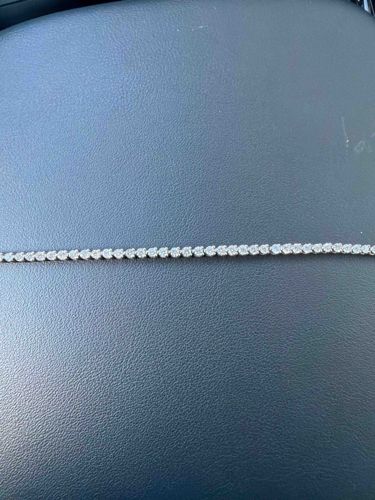
The item is a classic diamond tennis bracelet, characterized by a continuous, symmetrical line of individually set gemstones. Each gemstone, appearing to be a brilliant-cut diamond, is uniformly sized and appears to be set in a four-prong setting, allowing maximum light exposure and sparkle. The metal of the setting appears to be a white metal, likely white gold or platinum, given its bright, reflective quality and common use in fine jewelry with diamonds. The bracelet is slender and elegant, designed for constant wear or special occasions. The individual settings are linked together seamlessly, creating a flexible and articulate piece that drapes gracefully. Due to the limited visual information, specific carat weight, diamond clarity, or color cannot be precisely determined without magnification and further inspection. However, the stones appear well-matched in size and brilliance, suggesting a quality assembly. There are no visible chips, cracks, or significant wear evident from the provided image. The overall condition appears excellent, with no obvious signs of damage or repairs. No manufacturer's marks or signatures are discernible, and no clasp is visible in the presented view. This style of bracelet has been popular since at least the 1970s and continues to be a timeless piece of fine jewelry, suggesting an estimated age from a few years old to several decades, depending on its specific provenance. The craftsmanship appears clean and precise, indicative of a well-made piece of jewelry.
AI Appraisal Report
Based on my visual examination of the provided image, I assess this classic diamond tennis bracelet to be in excellent condition. The diamonds appear well-matched in size, brilliance, and overall quality, set uniformly in what I believe to be a white metal, likely 14k or 18k white gold, given its reflective quality and common use in fine diamond jewelry. The four-prong settings allow for optimal light exposure, maximizing the perceived sparkle. The seamless linking indicates good craftsmanship, contributing to the bracelet's elegant drape and flexibility. No visible damage, chips, cracks, or significant wear could be discerned from the image, suggesting careful ownership.
Market conditions for classic diamond tennis bracelets remain strong, as they are timeless and highly sought-after pieces. Demand is consistently high for well-made examples with quality diamonds. Rarity is not a significant factor here, as tennis bracelets are widely produced; however, the quality of the individual diamonds and the overall craftsmanship significantly impact value. The primary factors influencing this value are the collective carat weight of the diamonds, their color and clarity grades, and the purity of the metal. Without physical inspection, I cannot ascertain these specifics, which are crucial. Given the visual appearance of good quality diamonds, a conservative estimate for a bracelet of this style and apparent quality, likely totaling 3-5 carats, would fall into the stated range.
Limitations regarding authenticity verification from images alone are significant. While the piece looks authentic, I cannot definitively confirm the diamonds are natural, nor can I accurately grade their 4Cs (carat weight, cut, color, clarity). The metal content and purity also cannot be verified. For full authentication and a precise valuation, an in-person examination by a gemologist is essential. This would involve professional weighing, measurement, microscopic examination for clarity characteristics, color grading, and testing for diamond origin (natural vs. lab-grown), as well as metal testing. Provenance documentation, if available, would further enhance certainty regarding age and origin.