AI estimate as of October 27, 2025 · verify with a professional before acting
AI-Generated · Verify before acting
Everything on this page is generated by AI for informational purposes only. AI can make mistakes — the AI may misidentify items or misattribute them (artist, maker, brand, designer, origin, era). This is not an official valuation and should not be used for insurance, sale, tax, estate, legal, or lending purposes — or any decision requiring a certified appraisal. It is not an authoritative claim about any person, brand, or rights holder — do not share or rely on it as a factual statement about a third party. Always consult qualified professionals before making financial decisions.
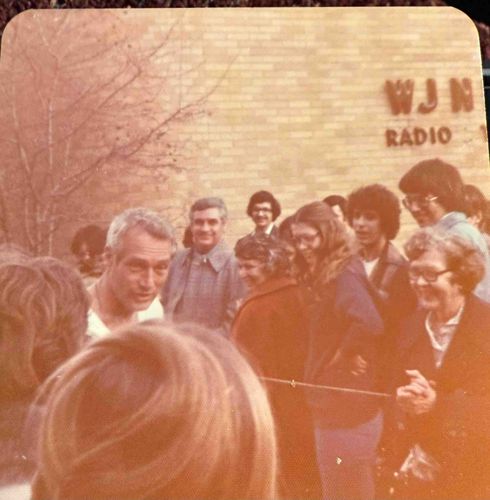
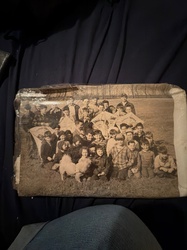
This item is a vintage color photograph, likely printed on photographic paper, capturing a group of people gathered outdoors in front of a brick building. The most prominent figure, identifiable as actor Paul Newman, is visible in the left foreground, featured with his distinctive blue eyes and a white shirt. He appears to be engaging with an unseen individual in the immediate foreground, whose back of the head and blonde hair are visible. Behind Newman and to his right, a crowd of individuals, primarily women and some men, are gathered. The background features a light-colored brick building with 'WJN RADIO' clearly visible in raised, dark lettering. A bare tree, consistent with late fall or winter, is visible on the left side of the frame, suggesting the time of year. The photograph exhibits significant age-related wear, characterized by a dominant orange or reddish color shift (color cast) across the entire image, indicating dye fading or improper storage. The corners of the photo appear rounded, which was a common photographic finishing style in the mid to late 20th century. There are also visible dark specks or dust particles on the emulsion surface, and general softening of detail likely due to age, printing methods of the era, and potential wear to the physical print. The image dimensions, based on the provided crop, suggest it may be a standard snapshot size, perhaps 3.5x5 inches or 4x6 inches. The overall condition suggests it was stored without archival protection. The style and visual cues, particularly the clothing and hairstyles of the individuals, along with the film characteristics, place its estimated age in the 1970s, making it a valuable piece of historical media documenting a public appearance by Paul Newman.
AI Appraisal Report
Based on my visual examination of the provided image, this vintage color photograph of Paul Newman at WJN Radio appears to be an authentic period piece from the 1970s, as suggested by the clothing, hairstyles, and overall photographic characteristics. The presence of Paul Newman himself provides significant intrinsic value. However, the condition of the photograph is a major detractor. The pervasive orange/red color shift is indicative of severe dye fading, likely from improper storage and exposure to light, significantly diminishing its aesthetic appeal and collectibility. There are also visible dust specks, rounded corners, and a general softening of detail which further impair its condition.
Market demand for Paul Newman memorabilia, especially candid or unique photographs, is generally strong. However, this particular item's condition will limit its appeal to serious collectors who often prioritize well-preserved pieces. Comparable sales for candid, unframed, and unautographed vintage photographs of similar celebrity stature and condition typically fall within the $100-$300 range. Better conditioned examples, or those with unique historical significance, could fetch higher prices. The WJN Radio context adds a specific historical detail but doesn't dramatically elevate the value without further context or rarity.
For a definitive appraisal and full authentication, a physical examination would be crucial. This would allow me to assess the paper type, print process, and actual extent of the damage beyond what a digital image conveys. Verification of the photographic print type (e.g., C-print, dye transfer) could also impact value. Furthermore, any provenance documentation — such as who took the photograph, its publication history, or original ownership — would significantly add to its authenticity and market value. Without such physical inspection and provenance, authentication relies solely on visual cues from the provided digital representation.