These notes were written by the person who submitted this item. Appraiser.AI has not verified them, and the AI's identification and estimate may rely on them.
AI Estimated Value
Not an official valuation
$2,500-4,000
AI estimate as of September 18, 2025 · verify with a professional before acting
AI-Generated · Verify before acting
Everything on this page is generated by AI for informational purposes only. AI can make mistakes — the AI may misidentify items or misattribute them (artist, maker, brand, designer, origin, era). This is not an official valuation and should not be used for insurance, sale, tax, estate, legal, or lending purposes — or any decision requiring a certified appraisal. It is not an authoritative claim about any person, brand, or rights holder — do not share or rely on it as a factual statement about a third party. Always consult qualified professionals before making financial decisions.
This analysis also relies on unverified notes provided by the user, which may be incomplete or inaccurate and could affect the result.
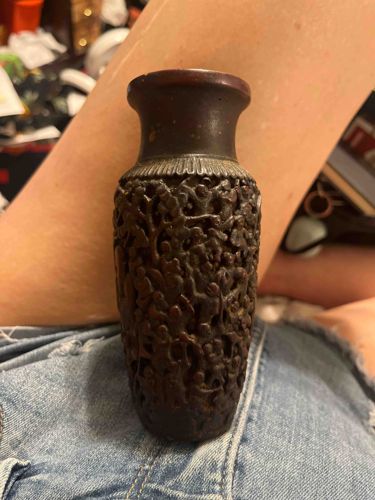
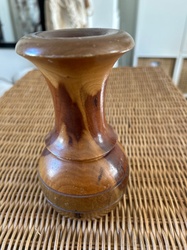
This item is a Chinese wood carved vase, distinguished by its intricate relief carving. The primary material appears to be a dark, dense hardwood, possibly zitan or hongmu, which has developed a rich, dark brown patina over time, indicative of age and handling. The vase is cylindrical in form with a slightly flared rim at the top and a narrower base. The central body of the vase is almost entirely covered with extremely detailed and densely packed carvings depicting numerous figures, consistent with the 'One Hundred Boys' motif ('Bai Zi Tu' in Chinese culture), symbolizing good fortune, prosperity, and numerous descendants. These figures are shown in various lively poses, suggesting playful activities. The carving is deeply undercut, creating a three-dimensional effect and significant texture, suggesting a high level of craftsmanship. Above the main carved body, there is a distinct neck section that is smoother but features a band of finely carved, stylized foliage or geometric patterns just below the rim. The rim itself is simple and slightly everted. While the exact dimensions are not provided, it appears to be a medium-sized decorative vase, suitable for display. Visible condition issues are minimal from the provided images, with the dark wood naturally obscuring minor wear, though the overall patina suggests age rather than significant damage. There are no overt signs of repair, and the integrity of the delicate carving appears to be well-preserved. There are no discernible maker's marks or signatures visible from the provided images. Based on the style and craftsmanship, this piece likely dates from the late Qing Dynasty to the early Republican period, though a more precise dating would require direct examination. The quality of the carving, with its fine details and depth, indicates a skilled artisan. The unusual aspect is the sheer density and minute detail of the 'One Hundred Boys' motif, which is a popular but challenging theme to execute with such intricacy in wood.
AI Appraisal Report
Upon examining the images of this Chinese wood carved 'One Hundred Boys' vase, I am genuinely impressed by its intricate relief carving. The dark, dense hardwood, likely zitan or hongmu, exhibits a rich, dark brown patina, strongly suggesting considerable age and handling. The 'One Hundred Boys' (Bai Zi Tu) motif is executed with exceptional detail and density across the vase's body, symbolizing prosperity and numerous descendants. The deeply undercut carving creates a remarkable three-dimensional effect, indicative of high craftsmanship. The condition appears excellent with no overt signs of repair visible. Based on the style and quality, I estimate its age to be late Qing Dynasty to early Republican period.
Market conditions for finely carved Chinese decorative arts, particularly those with auspicious motifs like the 'One Hundred Boys,' remain robust. Comparable pieces of similar intricacy and material quality have seen strong demand in recent auctions and private sales, although a wooden vase of this specific form and subject is less common than, say, a brush pot. The sheer density and minute detail of the carving are exceptional, distinguishing it from more common examples and contributing significantly to its rarity and appeal.
Factors positively impacting value include the high quality of the carving, the desirable 'One Hundred Boys' motif, the likely valuable hardwood, and the excellent apparent condition. However, it's crucial to note that this assessment is based solely on images. Full authentication and a more precise valuation would require a physical examination to confirm the wood species, assess any subtle repairs not visible in photos, and verify carving techniques firsthand. Provenance documentation, if available, would further enhance its value and authenticity.