AI estimate as of July 19, 2025 · verify with a professional before acting
AI-Generated · Verify before acting
Everything on this page is generated by AI for informational purposes only. AI can make mistakes — the AI may misidentify items or misattribute them (artist, maker, brand, designer, origin, era). This is not an official valuation and should not be used for insurance, sale, tax, estate, legal, or lending purposes — or any decision requiring a certified appraisal. It is not an authoritative claim about any person, brand, or rights holder — do not share or rely on it as a factual statement about a third party. Always consult qualified professionals before making financial decisions.
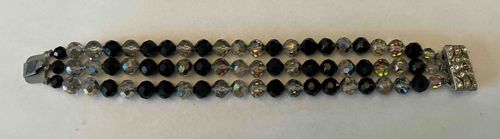
This item is a multi-strand beaded bracelet, featuring three parallel rows of faceted beads. The beads alternate between two primary types: opaque blackfaceted beads and translucent iridescent faceted beads, creating a striking contrast and visual interest. The iridescent beads exhibit a multifaceted play of colors, particularly hues of gray, green, purple, and yellow, depending on the light and angle, typical of an Aurora Borealis (AB) coating. Each bead appears to be approximately 5-7mm in diameter. The bracelet is secured by a flat, rectangular-shaped clasp that appears to be made of a silver-toned metal, possibly rhodium-plated base metal or a similar alloy, given its slightly dulled luster. One end of the clasp features a hook, while the other end has rings for attachment, indicative of a tongue-and-groove or box clasp mechanism. The clasp itself has a textured or decorative surface, possibly embellished with small, unidentifiable design elements or a stippled finish, though no specific gemstones or marcasites are clearly visible. The overall condition appears to be good for its presumed age, with minor wear consistent with use, particularly on the metal clasp which shows some scratches and darkening, suggesting patina or loss of plating. No major damage such as broken strands or missing beads is apparent. The construction appears to be well-strung, with the beads tightly arranged on flexible threads. Based on the style of the beads and clasp, this piece likely dates from the mid-20th century, possibly 1950s-1970s, which was a popular period for faceted glass or crystal beaded jewelry with iridescent finishes. The craftsmanship seems to be standard for mass-produced costume jewelry of that era.
AI Appraisal Report
Upon visual examination, this multi-strand faceted bead bracelet appears to be in good vintage condition, consistent with a piece dating from the mid-20th century, likely 1950s-1970s. The alternating black and iridescent (Aurora Borealis) faceted beads, approximately 5-7mm, are a common feature of costume jewelry from that era. There are no apparent missing beads or broken strands, which is positive for its value. The silver-toned metal clasp, likely a rhodium-plated base metal, shows visible wear, including scratches and darkening, suggesting either patina or loss of original plating. This wear is typical for costume jewelry of this age and impacts its aesthetic appeal, but not its structural integrity significantly.
Authenticity is difficult to definitively confirm from images alone. While the style strongly suggests a vintage costume piece, an in-person examination would allow for closer inspection of the bead material (glass vs. plastic), actual clasp mechanism, and overall construction quality. Without physical handling, it's impossible to rule out modern reproductions. Provenance documentation, though unlikely for this type of item, would add to historical authenticity. Scientific testing, like metal analysis of the clasp, is not typically warranted for costume jewelry of this value category.
Market conditions for vintage costume jewelry are steady, with demand for well-preserved, classic designs. Comparables typically sell in the low to mid-range for similar multi-strand beaded bracelets. This piece is not rare; similar styles were mass-produced. Its value is primarily driven by its good condition for a vintage item and classic appeal. The non-precious materials and mass-produced nature limit its top-tier value. The clasp's condition is a minor detractor.
Overall, the limitations from image-only appraisal mean assumptions about bead material and detailed clasp condition are based on typical examples of the era. A physical inspection would confirm these details.