AI estimate as of June 27, 2025 · verify with a professional before acting
AI-Generated · Verify before acting
Everything on this page is generated by AI for informational purposes only. AI can make mistakes — the AI may misidentify items or misattribute them (artist, maker, brand, designer, origin, era). This is not an official valuation and should not be used for insurance, sale, tax, estate, legal, or lending purposes — or any decision requiring a certified appraisal. It is not an authoritative claim about any person, brand, or rights holder — do not share or rely on it as a factual statement about a third party. Always consult qualified professionals before making financial decisions.
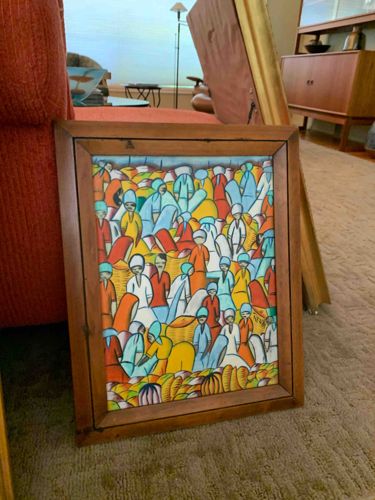
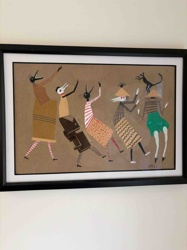
This is a vibrant framed folk art painting, likely executed on a hardboard or canvas substrate, encased within a simple, dark-stained wooden frame. The frame appears to be of solid construction, possibly oak or a similar hardwood, with visible wear and minor scuffs along its edges and corners, suggesting age and handling, including some areas where the lighter wood shows through the stain. The painting itself depicts a densely populated market scene, characteristic of a bustling village or town square. Figures are rendered in a distinctive folk art style, characterized by simplified, almost abstract forms, bold, thick black outlines, and flat, ungraduated fields of striking color. The color palette is exceptionally bright and warm, dominated by vivid blues, sunny yellows, fiery oranges, deep reds, and crisp whites, with touches of green and brown. No individual faces are discernible, enhancing the collective feel of the scene, with each figure contributing to the overall pattern. Many of the stylized figures, both male and female, are depicted wearing traditional head coverings and simple garments. Some are shown carrying large baskets on their heads or interacting with goods, such as various fruits and vegetables, neatly arranged in the foreground. The composition lacks traditional perspective, with figures stacked vertically to fill the entire picture plane, creating a dynamic, mosaic-like pattern. While no specific artist's signature or maker's mark is visible in the provided image, the style strongly evokes the naive art traditions found in regions like Haiti or other parts of the Caribbean, known for their expressive portrayals of daily life and market scenes. The artwork appears to be in good condition with no obvious damage, fading, or paint loss, maintaining its intense luminosity. The craftsmanship, while adhering to the folk art aesthetic, is consistent and demonstrates a deliberate hand in its execution, making it a genuine example of this artistic genre, likely dating from the mid to late 20th century.
AI Appraisal Report
Based on my visual examination of the provided image, this Framed Folk Art Market Scene Painting appears to be a genuine representation of the genre, likely dating from the mid to late 20th century. The painting itself is in remarkably good visual condition, showing no apparent fading, significant paint loss, or damage, retaining its intense luminosity. The dark-stained wooden frame exhibits minor scuffs and wear consistent with its age and handling.
The strong, vibrant color palette and distinctive naive style, characterized by bold outlines and simplified forms, are hallmarks of traditional folk art, particularly evoking Caribbean or Haitian traditions. Demand for such engaging and colorful narrative folk art remains steady within a niche market of collectors and decorators valuing authentic cultural expressions. Comparables would include other anonymous or lesser-known 20th-century folk pieces depicting similar bustling scenes, where aesthetic appeal and condition significantly influence value.
Key factors impacting its value positively are its excellent visual condition, captivating subject matter, and strong artistic execution inherent to the genre. Conversely, the absence of a discernible artist's signature and detailed provenance limits its top-tier value, as pieces by known folk artists command substantially higher prices.
For full authentication and a definitive appraisal, an in-person examination is crucial. This would allow for a tactile assessment of the substrate (hardboard/canvas), paint medium, and frame construction. UV light analysis could reveal hidden signatures, previous repairs, or overpainting. Furthermore, provenance documentation or material analysis could conclusively confirm its origin, period, and potentially attribute it to a specific artist or atelier, which are currently indeterminable from images alone.