These notes were written by the person who submitted this item. Appraiser.AI has not verified them, and the AI's identification and estimate may rely on them.
AI Estimated Value
Not an official valuation
$350-550
AI estimate as of August 8, 2025 · verify with a professional before acting
AI-Generated · Verify before acting
Everything on this page is generated by AI for informational purposes only. AI can make mistakes — the AI may misidentify items or misattribute them (artist, maker, brand, designer, origin, era). This is not an official valuation and should not be used for insurance, sale, tax, estate, legal, or lending purposes — or any decision requiring a certified appraisal. It is not an authoritative claim about any person, brand, or rights holder — do not share or rely on it as a factual statement about a third party. Always consult qualified professionals before making financial decisions.
This analysis also relies on unverified notes provided by the user, which may be incomplete or inaccurate and could affect the result.
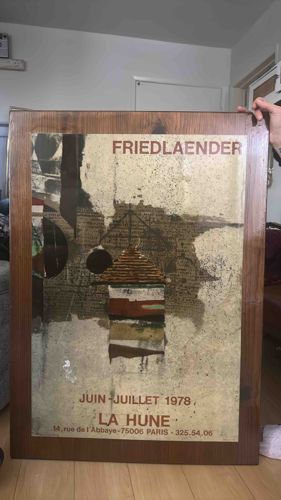
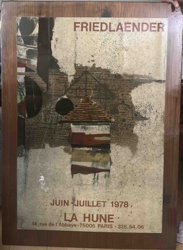
This item is an exhibition poster for 'FRIEDLAENDER' at 'LA HUNE', running from June-July 1978. The physical characteristics indicate a substantial poster, likely printed on heavy paper or cardstock, housed within a visibly robust wooden frame. The frame appears to be made of a solid wood with a warm, reddish-brown stain and a visible grain pattern, suggesting a natural wood finish. The poster itself features a mixed-media or abstract design with distressed textures, incorporating what appears to be torn or layered paper elements, possibly resembling newsprint or aged documents. Dominant colors in the artwork include earthy tones such as browns, muted greens, and reds, against a lighter, possibly off-white or beige background. A central motif resembles a stacked structure with a textured, possibly tiled, conical top. The text 'FRIEDLAENDER', 'JUIN-JUILLET 1978', 'LA HUNE', and the address '14, rue de l'Abbaye-75006 PARIS - 325.54.06' are printed clearly on the poster, indicating the artist, dates, gallery, and contact information. Visible condition issues include potential wear to the frame, consistent with its age, though specific damage is not clearly discernible from the image. The poster itself has an inherent distressed aesthetic, making it difficult to differentiate intentional design elements from actual wear, but it appears to be well-preserved within its frame. The overall style is characteristic of late 20th-century abstract art or graphic design, specifically exhibition posters from the 1970s. The craftsmanship of the poster printing appears to be of good quality, given its legibility and color saturation, while the framing is sturdy.
AI Appraisal Report
Based on my visual examination of the provided image, this Friedlaender Exhibition Poster (La Hune, June-July 1978) appears to be in good overall condition. The inherent distressed aesthetic of the design makes it challenging to discern actual wear from intentional elements without physical inspection, but no significant damage is immediately apparent. The text is clear and colors remain vibrant, suggesting good preservation. The robust wooden frame, consistent with its age, exhibits a warm, reddish-brown stain; while potential minor wear is expected for a vintage frame, none is clearly discernible here.
Regarding authenticity, the visible text 'FRIEDLAENDER', 'JUIN-JUILLET 1978', 'LA HUNE', and the specific address clearly identify the exhibition and gallery, aligning with known historical records for Friedlaender's work and exhibitions of that period. Exhibition posters from established artists like Friedlaender generally have a consistent market, driven by collectors interested in the artist's oeuvre, graphic design history, or specific art movements. Comparables for similar vintage exhibition posters by known artists from the 1970s often range from $200 to $800, depending on the artist's prominence, the rarity of the poster, and its condition. Factors impacting value here include the good apparent condition and its well-preserved framing, which adds to its presentation and protection. While not exceptionally rare, a well-preserved original poster from a notable artist holds stable demand among specialized collectors.
My primary limitation in this appraisal is the lack of physical examination. While the image suggests authenticity, a definitive verification requires in-person inspection to confirm paper quality, printing techniques, and potential signs of reproduction. Provenance documentation (e.g., original purchase receipts or exhibition catalogs) would further strengthen the authentication process. Scientific testing for paper aging or ink composition could also be employed for absolute certainty, though this is typically reserved for higher-value items.