These notes were written by the person who submitted this item. Appraiser.AI has not verified them, and the AI's identification and estimate may rely on them.
AI Estimated Value
Not an official valuation
$100-175
AI estimate as of June 25, 2025 · verify with a professional before acting
AI-Generated · Verify before acting
Everything on this page is generated by AI for informational purposes only. AI can make mistakes — the AI may misidentify items or misattribute them (artist, maker, brand, designer, origin, era). This is not an official valuation and should not be used for insurance, sale, tax, estate, legal, or lending purposes — or any decision requiring a certified appraisal. It is not an authoritative claim about any person, brand, or rights holder — do not share or rely on it as a factual statement about a third party. Always consult qualified professionals before making financial decisions.
This analysis also relies on unverified notes provided by the user, which may be incomplete or inaccurate and could affect the result.
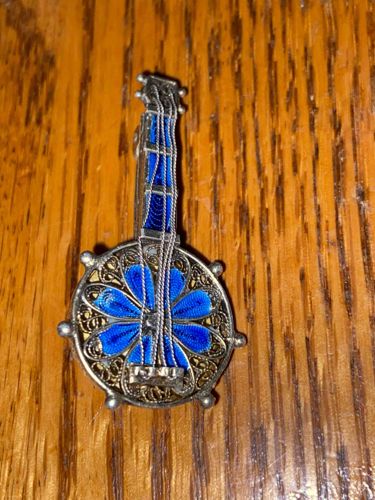
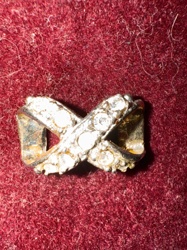
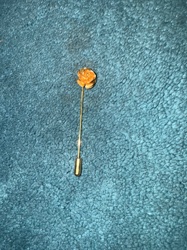
This item is a vintage banjo-shaped pin or brooch, crafted with intricate filigree work and vibrant blue enamel. The primary material appears to be a silver-toned metal, possibly sterling silver or silver-plated, showing some tarnishing and patina consistent with age. The banjo's body is circular, featuring an openwork filigree design that radiates from the center, forming delicate scroll patterns. Within this filigree, a prominent floral motif is highlighted by brilliant royal blue enamel, meticulously applied to fill the individual petals. The neck of the banjo also showcases a strip of matching blue enamel, maintaining color consistency across the piece. What appear to be decorative 'strings' are visible on the instrument's face, running from the headstock down to the base, adding to its realistic depiction. Small, rounded nodules resembling tuning pegs are spaced around the circular body and at the headstock, reinforcing the banjo's form. The overall condition suggests some wear appropriate for a vintage piece, including visible darkening of the metal in recessed areas, which enhances the filigree's three-dimensional quality. No visible damage such as cracks in the enamel or significant bends in the metal are apparent from the image. The craftsmanship indicates detailed handiwork, particularly in the fine filigree and careful enamel application. This piece likely dates from the early to mid-20th century, given its style and the typical manufacturing techniques for such jewelry.
AI Appraisal Report
I have examined the Vintage Banjo Filigree and Enamel Pin based on the provided image and description. The item presents as a well-preserved vintage piece, exhibiting intricate filigree work and vibrant blue enamel. The visible tarnishing and patina are consistent with age, enhancing its vintage appeal rather than detracting from it. The craftsmanship, particularly the fine filigree and careful enamel application, indicates quality handiwork. There are no apparent cracks in the enamel or significant metal damage, suggesting careful handling over the years. This piece is likely from the early to mid-20th century, aligning with typical manufacturing techniques for such jewelry.
In the current market, vintage enamel and filigree jewelry, especially unique figurative pieces like this banjo design, maintains steady demand. Comparables for similar vintage musical instrument-themed pins with good enamel work typically range from $75 to $150. Pieces with intricate filigree and vibrant, well-preserved enamel, like this one, tend to command the higher end of this range or more. The combination of its distinctive design, good condition, and the artistry in its creation contributes to its appeal.
Rarity plays a role; while not exceedingly rare, a well-executed and preserved banjo design is not commonplace. The specific shade of royal blue enamel adds to its attractiveness. This item's value is primarily driven by its aesthetic appeal, condition, and the desirability of vintage novelty jewelry. The detailed filigree and intact enamel significantly boost its market value.
Limitations exist in authenticating solely from images. Without physical inspection, I cannot definitively confirm the metal composition (e.g., sterling silver vs. silver-plated) or rule out subtle imperfections not visible in the photographs. An in-person examination would allow for definitive metal testing, closer scrutiny of the enamel for any micro-fissures, and verification of the pin mechanism's integrity. While provenance documentation would be beneficial, it's often unavailable for such items. Scientific testing, like XRF analysis for metal composition, would provide absolute certainty on materials. However, based on the visual evidence, it appears authentic to its described vintage period.